

Oil Transiting the Strait of Hormuz Primarily Belongs to Iran, Iraq, Kuwait, Saudi Arabia, and the UAE;
The Strait of Hormuz: The World’s $500 Billion Economic Artery
Rokna Political Desk: Tensions between Iran and the United States, combined with the annual transit of more than $500 billion worth of energy through the Strait of Hormuz, have turned this vital waterway into a strategic focal point for the global economy, where any disruption would deliver a major shock to international markets.
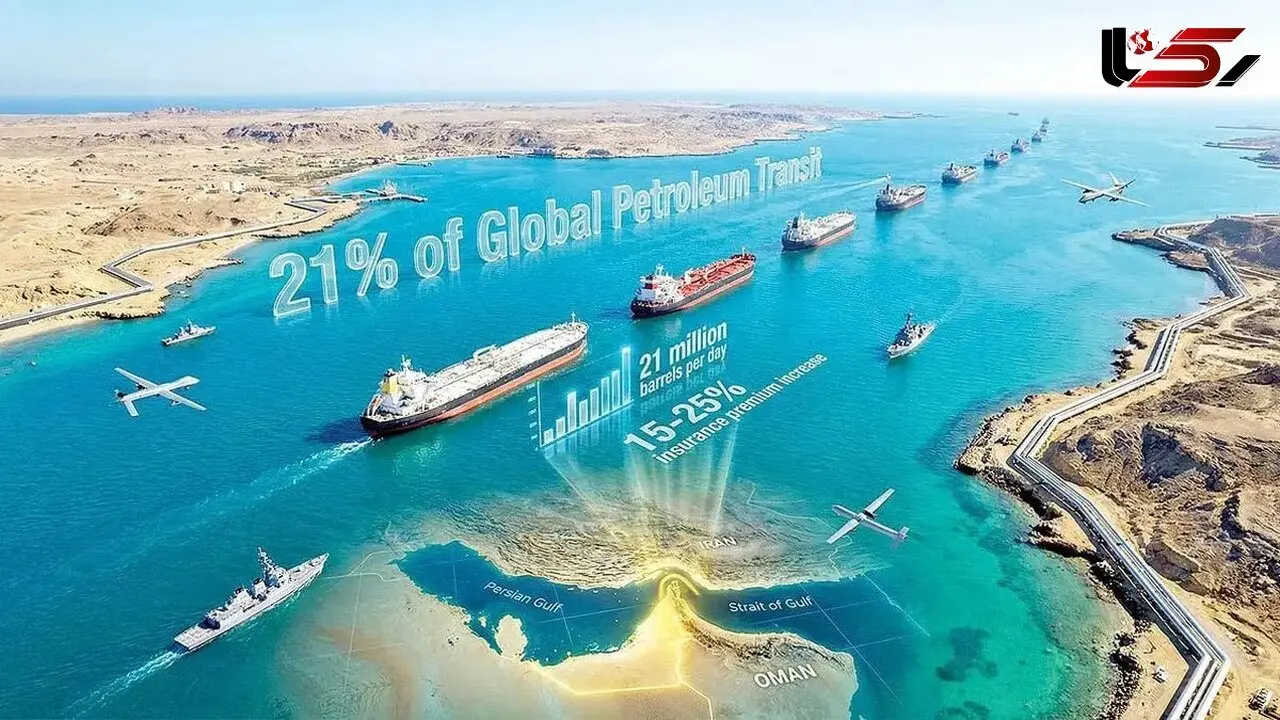
Under such circumstances, every military exercise, every political threat, and even every ambiguous security signal in this region is immediately reflected on oil and gas price boards, because even the slightest disruption in this strategic chokepoint can disturb the energy supply chain, trigger price surges, and confront energy-importing economies with an unprecedented and multi-layered shock — a shock whose effects extend from financial markets to manufacturing industries and household consumption. The deployment of the nuclear-powered aircraft carrier USS Gerald R. Ford to the Persian Gulf region, as part of one of the most extensive U.S. military deployments since the 2003 invasion of Iraq, has once again returned the possibility of direct confrontation to the forefront of energy analyses. In response, Tehran, by holding military exercises and announcing readiness to temporarily block parts of the Strait of Hormuz, has sent a clear signal regarding its deterrent tools — a message directed not only at Washington but also at global energy markets.
The Geography of a Strategic Chokepoint
The Strait of Hormuz lies between Iran to the north and Oman and the United Arab Emirates to the south. The waterway is approximately 50 kilometers wide at its entrance and exit points and narrows to about 33 kilometers at its narrowest section. Despite this limited width, the world’s largest oil tankers pass through this route. This passage constitutes the sole maritime link between the Persian Gulf and the Gulf of Oman and effectively serves as the main artery for oil and gas exports of the region’s major producers. According to data from the U.S. Energy Information Administration (EIA), in 2024 an average of approximately 20 million barrels of oil per day transited this strait — a figure equivalent to nearly 20 percent of global daily consumption. The annual value of this volume of energy trade is estimated at around $500 billion. The oil passing through Hormuz primarily belongs to Iran, Iraq, Kuwait, Qatar, Saudi Arabia, and the United Arab Emirates.
Hormuz: The Pulse of the Global LNG Market
The importance of the Strait of Hormuz is not limited to crude oil. Approximately one-fifth of global liquefied natural gas (LNG) trade also passes through this route. Qatar, as one of the world’s largest LNG exporters, accounts for the dominant share of this flow. In addition to exports, LNG imports to Kuwait and the UAE are also conducted via this route, including cargoes arriving from the United States or West Africa.
Statistics indicate that in 2024 approximately 84 percent of the oil and condensates transiting the Strait of Hormuz were destined for Asian markets. In the LNG sector, around 83 percent of shipments headed toward Asia. China, India, Japan, and South Korea collectively absorbed nearly 69 percent of the oil passing through this route. The industries, power plants, and transportation networks of these countries depend on the steady flow of energy from the Persian Gulf.
Iran’s Geopolitical Leverage
Under international law, countries exercise sovereignty up to 12 nautical miles from their coasts. In its narrowest section, the waterway and shipping lanes of Hormuz lie within the territorial waters of Iran and Oman — a reality that provides Tehran with significant geographic leverage. Approximately 3,000 vessels pass through this corridor each month. In the event of a decision to create disruption, one effective tool could be the deployment of naval mines by fast attack craft or submarines. Iran’s navy possesses a combination of missile-equipped fast boats, surface vessels, semi-submersible craft, and submarines designed for asymmetric warfare. Last year, the Islamic Consultative Assembly approved a proposal to close the strait, although the final decision in this regard rests with the Leader of the Islamic Republic. At the regional level, developments could become more complex. Yemen’s Ansarallah group has previously attempted to disrupt traffic in the Bab el-Mandeb Strait — a passage connecting the Red Sea to global trade routes. Simultaneous pressure on Hormuz and Bab el-Mandeb could significantly increase the systemic risk of energy transportation.
The Closure Scenario: A Potential Price Shock
Energy experts warn that any full or even partial closure of the Strait of Hormuz could have an immediate and severe impact on oil prices. Approximately 70 percent of OPEC+ spare production capacity is located in Persian Gulf countries; therefore, rapid replacement of disrupted supply is practically impossible. Saudi Arabia exports about 5.5 million barrels of oil per day through this passage — more than any other country in the region. Iran’s oil exports, roughly 90 percent of which are directed to China, averaged 1.7 million barrels per day in the first half of 2025. Although Saudi Arabia and the UAE possess limited pipelines to transport oil to the Red Sea or the port of Fujairah, the capacity of these routes is insufficient to fully replace maritime exports. Some producers maintain overseas storage reserves that could mitigate the impact in the short term; however, in the event of a serious and prolonged disruption, this protective buffer would not suffice. In such a scenario, a price surge above $100 per barrel would not be unexpected.
Macroeconomic Consequences
A sharp increase in energy prices translates into rising fuel, production, and transportation costs worldwide. China, which relies on industrial exports to sustain economic growth, is vulnerable to such a shock. Higher energy prices could strain global supply chains and generate a new wave of inflation. India sources nearly half of its oil imports and around 60 percent of its natural gas requirements via Hormuz. South Korea receives about 60 percent of its oil, and Japan nearly three-quarters of its oil imports, through this passage. For these economies, any interruption means direct pressure on growth and financial stability. Even in Persian Gulf countries, disruption in Hormuz could undermine investment. Ambitious development projects, including those related to Saudi Arabia’s Vision 2030, depend on energy market stability.
Playing with Systemic Risk
The Strait of Hormuz is not merely a maritime route; it is the intersection of geopolitics and the global economy. Although historical experience indicates that regional actors tend to avoid a complete closure of this artery, rising tensions have demonstrated that energy markets remain vulnerable to political developments. A closure of Hormuz would not only sharply increase oil and LNG prices, but could also trigger a wave of economic instability across Asia, Europe, and even the Middle East itself — a wave that would begin in energy markets and quickly spread to currency markets, equities, and essential commodities. Rising energy prices would elevate production costs in major industries, reduce corporate profit margins, and impose renewed inflationary pressure on consumers. For energy-importing economies in East Asia, this would mean widening trade deficits and weakening economic growth; for Europe, intensified concerns over energy security; and for regional exporting countries, the risk of reduced investment and financial instability. At a time when the global economy continues to grapple with inflationary challenges, high interest rates, and signs of recession, any shock in this vital artery could activate a chain of financial and commercial reactions whose scope would extend far beyond a regional crisis — a crisis that would affect not only the oil market but also the architecture of global economic stability.
Send Comments