

Baqaei: We Have No Preconditions for Agency Visits / Our Military Forces Are More Alert During Negotiations
Rokna Political Desk: The spokesperson of Iran’s Ministry of Foreign Affairs stated that previous experiences cannot be forgotten. While we are at the negotiation table, our military forces are certainly more alert.
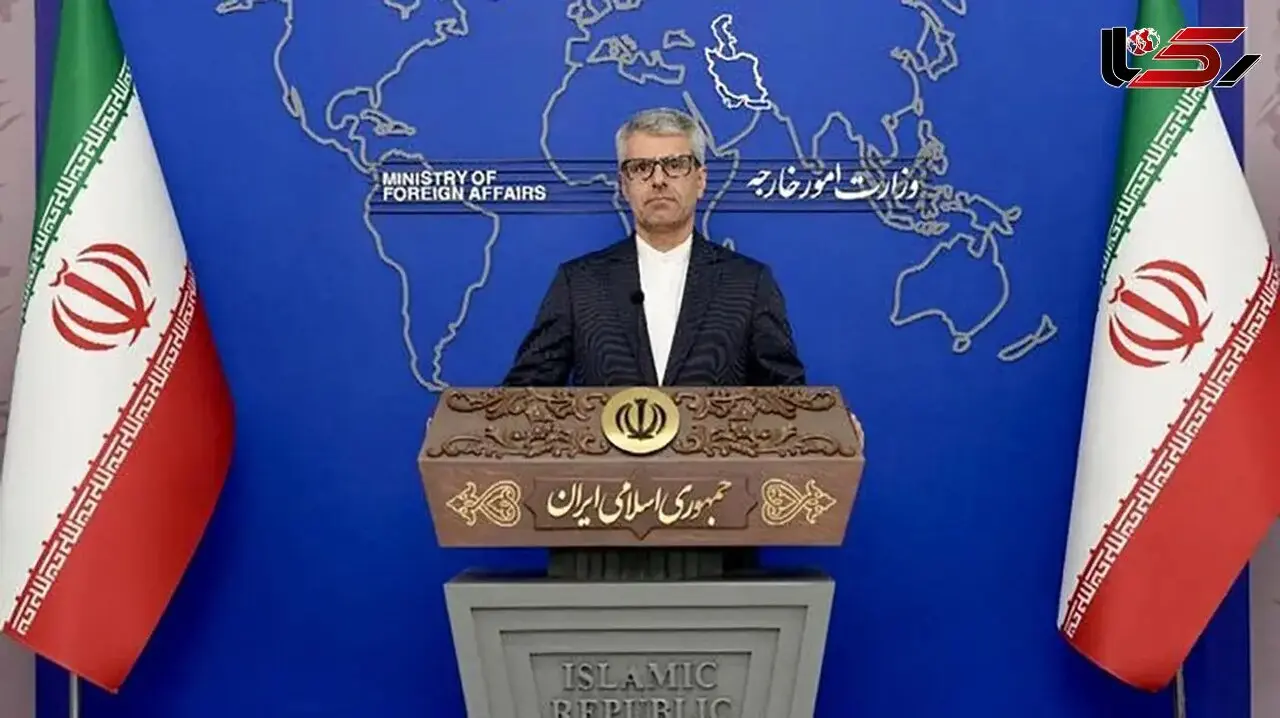
Esmaeil Baqaei, spokesperson of the Ministry of Foreign Affairs, said today (Monday) during a press conference, while congratulating the public on the month of Ramadan, regarding the draft proposals of Iran and speculations about a temporary agreement between Iran and the United States: “There is much speculation about the course of the negotiations, and we do not confirm any of these speculations.”
He added: “Drafting any negotiation text is naturally a joint task in any negotiation process. Our positions on the U.S. unjust sanctions are clear, and we are fully aware of the American viewpoints. We are currently in the process of drafting our positions and hope to have another round of discussions within the next two to three days.”
Regarding Witkoff’s interview, in which he implicitly demanded Iran’s surrender and claimed that Iran is a week away from nuclear weapons, Baqaei said: “This is not the first time we have encountered contradictory statements. I leave the judgment to the discerning people of Iran.”
Iran Is Serious About the Diplomatic Path
The Foreign Ministry spokesperson emphasized: “No negotiation whose goal is to force one party into accepting the other’s demands will succeed. Iran is serious in pursuing the diplomatic path because we are confident in the legitimacy of our positions. We will continue steadfastly and confidently, relying on the solid foundations of our demands in the nuclear field and in lifting sanctions.”
Regarding Ali Larijani’s visit to Oman, Baqaei said: “I need to verify this news, and I have no information about such a trip.”
We Have No Preconditions for Agency Visits
Baqaei addressed the remarks of Rafael Grossi regarding the Agency’s visits to Iran’s facilities, saying: “We have no preconditions for Agency visits. Cooperation with the Agency is a separate matter. The issue of visiting damaged facilities is different because there is no inspection procedure available.”
Commenting on Witkoff’s claim about Trump’s surprise at Iran’s refusal to surrender, he said: “This confidence comes from our belief in our own legitimacy, and in Iran’s history and civilization. Fundamentally, the behavior and actions of Iranians show that they do not favor surrender. The demand of Iranians is dignity, respect, and preservation of territorial integrity. Surrender is incompatible with all international norms. Naturally, a nation that has decided to pay for its dignity will continue steadfastly on this path.”
Regarding Iran’s reaction to the European Union labeling its forces as terrorist, he said: “Our statement is based on the Parliament’s resolution. The EU’s resolution is certainly contrary to the principles and fundamental rules of international law and was an unjustified act. Under no circumstances is it permissible to label the official forces of a country. Our response was in opposition to this action. From now on, European forces in our region will be regarded differently. From now on, they are considered terrorist, with all the consequences and implications this entails.”
Iran’s Proposal at the Geneva Nuclear Disarmament Meeting
Baqaei stated: “This proposal has been raised decades ago and is in line with fulfilling one of the principles outlined for the nuclear disarmament of nuclear-armed countries. These countries have constantly taken steps to advance their arsenals. This is a public demand for the implementation of the Non-Proliferation Treaty.”
Regarding claims of conflict between the Ministry of Foreign Affairs and Shaham about the negotiations, he said: “Regarding the nuclear issue, we act based on decisions made by the Supreme National Security Council. All relevant bodies participate in this process and express their viewpoints. Ultimately, decisions are made in the Supreme National Security Council.”
The Term ‘Surrender’ Is Unacceptable to Us
Baqaei emphasized Iran’s determination to stand against U.S. overreach: “This confidence comes from our belief in our own legitimacy, history, and culture. The term ‘surrender’ is unacceptable to us. The behavior and actions of Iranians have shown that they do not compromise. From the perspective of international law, the idea of surrender is incompatible with all principles and rules. All countries have equal membership in the United Nations, and any interaction must be based on respect for state sovereignty.”
On recognizing Afghanistan’s caretaker government, he said: “Our relations with Afghanistan are based on mutual respect, reciprocal relations, and shared religious and cultural foundations. We share common concerns, including border insecurity, narcotics, and water issues. Communications and exchanges between the two countries continue at a good level. The recognition issue has long been raised. It is a political matter, and whenever a final decision is reached, we will announce it.”
Regarding remarks by Araqchi on accepting the Additional Protocol, Baqaei said: “We implemented the Additional Protocol voluntarily during the JCPOA. Therefore, we have prior experience. Such voluntary decisions are conditional upon discussions regarding sanctions relief. This issue is historically precedent-based and a tool to assure Iran’s peaceful nuclear program.”
Reacting to claims that Iran is prolonging the negotiations, he stressed: “This has no basis. We have repeatedly stated that we are willing to continue negotiations for weeks without interruption to reach a result. Holding negotiations every ten days is not our preferred option. Beneficial negotiations for us are those that lead to results. Reason dictates that we act to lift sanctions as soon as possible.”
Regarding Araqchi’s remarks on Europe’s bitter experience with the JCPOA, Baqaei said: “We are focused on advancing Iran’s national interests.”
On warnings by some countries to their citizens to leave Iran, he stated: “For the past 24 hours, you have witnessed a psychological and media war. Our people are facing an unprecedented psychological campaign in history, yet they have understood well that confronting this war requires conscious behavior. Travel continues, and we cannot definitively claim that everyone is leaving or arriving.”
Iran’s Reaction to ISIS Transfers from Syria
Regarding the escape of approximately 15,000–20,000 ISIS elements from the al-Hol camp in Syria and the transfer of some ISIS prisoners to Iraq with third-party involvement, and Iran’s concerns about the potential reconstruction of extremist networks and new security threats to regional countries, he said: “This is a significant matter. Iraq, Iran, and Syria have paid a heavy price. We have experienced the severe costs of combating ISIS. Iran, Iraq, and Syria have paid dearly. The whole world benefited from Iran’s sacrifices. Naturally, Iran is concerned about any development that could facilitate terrorism in the region. We have conveyed our concerns to our Iraqi friends. Certainly, the Iraqis themselves are aware of the risks.”
Regarding Nancy Pelosi’s statements about applying economic pressure on the Iranian people, he said: “There is no doubt about the purpose of sanctions. Previously, it was justified as ‘support for the Iranian people,’ but in recent years they explicitly state that the aim is to pressure Iranian citizens to feel the impact and protest against the government. These admissions emphasize America’s responsibility at all levels. U.S. accountability never ends due to their crimes.”
On Araqchi’s remarks about the possibility of a better agreement than the JCPOA, Baqaei said: “Our duty as a diplomatic body is to secure the rights of the Iranian nation. Naturally, we can accept an understanding that includes the assurance of Iran’s rights, both in nuclear and sanctions matters. It is important that the counterpart reaches the conclusion that Iran’s nuclear program is peaceful. This trust-building is entirely achievable, as there has been no deviation in our program. If they are serious about the claim that Iran will not reach nuclear weapons, this matter is attainable.”
Iran’s Proposal Package by Thursday
Regarding the negotiations on Thursday and whether the U.S. intends to propose a plan, he said: “One of the indicators of seriousness in any negotiation is that all parties strive with goodwill and determination to reach a result. Drafting any document requires cooperation, participation, and assistance from all negotiating parties, and we are engaged in this work on our part. The elements we consider for any potential understanding are being consolidated.”
Baqaei continued: “The method the U.S. delegation will adopt must be asked from them. Naturally, the American side has its views, which we are fully aware of.”
When asked whether Iran’s proposed package will be ready by Thursday, he replied: “It will be discussed with the Omani mediator, and the form is not important; what matters is that we are working on it.”
For Israel, There Is No Difference Between Shia, Sunni, Arab, or Non-Arab
Reacting to statements by Israeli officials about countering the Shia axis, the spokesperson said: “A camel in sleep sees a seed of cotton; the important point in this statement is that for Israel, there is no difference between Shia and Sunni, Arab or non-Arab. They have repeatedly emphasized that their goal is domination over the entire region. They named Arab countries whose lands must be annexed to Israel. Such statements increasingly signal to our friends in the region that the immediate danger is the Israeli regime, and greater cooperation is required before it is too late to counter such dangerous delusions.”
Regarding whether the Foreign Ministry has a plan to determine Israel’s role in negotiations, he said: “The regime has had a fixed role in the negotiation process, which was destructive. The survival of the regime depends on perpetuating insecurity and chaos in West Asia. This regime has friends in the West, so they try to turn the slogan ‘America First’ into ‘Israel First.’”
Our Military Forces Are More Alert During Negotiations
Responding to U.S. threats against Iran during negotiations, Baqaei said: “If it leads to war, our fighters will respond. Our forces are vigilant 24/7 to defend Iran’s integrity. The Foreign Ministry’s duty is diplomacy. During these two rounds of negotiations, Iran’s interests and rights were firmly upheld. Iran remains committed to advancing its national interests and rights regardless of these threats. Whenever we sense that the counterpart is trying to exploit this process for deception, we will take appropriate positions. We cannot forget previous experiences. While at the negotiation table, our military forces are certainly more alert.”
Regarding the start of operations of Russia’s VTB Bank in Iran, he said: “One of the core tasks of the Foreign Ministry in economic diplomacy is this, and necessary measures to facilitate it are certainly being taken.”
On the timing of sending Iran’s proposed text for negotiations, he added: “How and when it will happen is being discussed with our Omani mediator. We are working on consolidating views on all aspects of forming an agreement.”
Reacting to Witkoff’s statements about zero enrichment and Trump’s negotiation deadline, he said: “If we look at it with goodwill, we attribute it to a linguistic mistake. This discussion is completely incorrect. But I don’t think anyone doubts that contradictions from U.S. officials are a major obstacle in the negotiation process. We act based on our own interests and priorities.”
Grossi’s Presence in the Next Negotiation Round Is Being Discussed
Regarding a question about Araqchi’s statement that inspections of damaged facilities require a mutually agreed framework between Iran and the Agency and whether a new agreement with the Agency will be reached, and if Grossi will attend the Thursday negotiations, he said: “The discussion regarding Grossi’s presence in the next negotiation round is ongoing, and I cannot give a definitive opinion yet. Regarding visits to damaged sites, this is a matter between us and the Agency, and fundamentally requires an agreement on a specific procedure, considering all aspects including the law passed by the Parliament and its intended procedure. We are not at that stage yet, although exchanges and communications with the Agency regarding cooperation continue continuously.”
Respect for Iran’s Right to Nuclear Energy
Referring to a win-win agreement, he emphasized: “An agreement that restores the diminished rights of Iranians is our main demand. In the nuclear field, Iran’s recognized rights must be respected. Respect for Iran’s right to peaceful nuclear energy is an integral part of any agreement.”
Regarding tensions between Pakistan and Afghanistan, he said: “The outbreak and escalation of tensions between the two countries will have consequences beyond them. Our constant recommendation is dialogue, restraint, and efforts to resolve disputes diplomatically. We have expressed our readiness to use good offices to prevent escalation. We hope this situation ends through dialogue based on goodwill between both sides.”
Responding to Canada’s conditional approach to relations with Iran, he emphasized: “The Canadian government should be concerned about its own situation, as the U.S. wants to annex it as its fifty-some state.”
Send Comments