

Russia Launches Major Assault on Kyiv Ahead of Trump-Zelensky Peace Talks
Rokna Political Desk:Russia launched a massive overnight attack on Kyiv, injuring at least eight people, just hours after Ukrainian President Volodymyr Zelensky announced plans to meet U.S. President Donald Trump in Florida to discuss a potential peace framework.
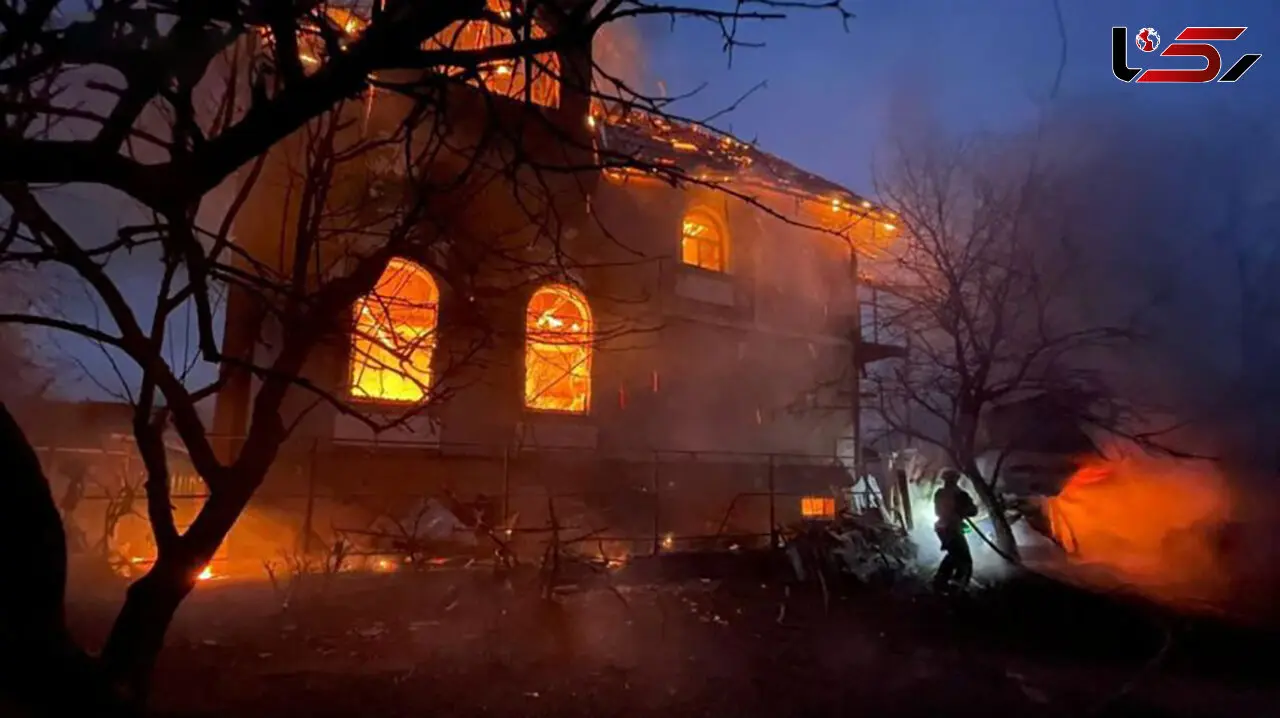
According to Rokna, citing CNN, Russia carried out a large-scale overnight assault on Kyiv shortly after Ukraine’s President Volodymyr Zelensky announced plans to meet U.S. President Donald Trump in Florida on Sunday, as international efforts continue to end the nearly four-year conflict in Eastern Europe.
On Friday, Zelensky cautioned that it was unclear whether the meeting would result in a formal agreement, but emphasized that both sides aimed to “finalize as much as possible.” Earlier that day, he expressed optimism on X, stating that “many decisions could be made before the New Year.”
Zelensky informed reporters that the 20-point peace plan developed by Ukrainian and U.S. officials is “90% complete,” and he intends to discuss with Trump how Ukraine’s allies might ensure the country’s future security. In an interview with Politico, Trump said he expects the meeting to “go well,” but noted that Zelensky “won’t have anything until I approve it.” He added that he also anticipates speaking with Russian President Vladimir Putin “soon, as much as I want.”
Less than 24 hours later, Russia launched a significant aerial strike on Kyiv, injuring at least eight people, city officials reported. A CNN correspondent in the capital heard attack drones overhead and a series of explosions early Saturday, during which Air Force alerts were active. Fires broke out across the city, engulfing a car repair shop and several residential buildings, and forcing elderly residents to evacuate a care facility as flames spread, according to Kyiv Emergency Service.
“Kyiv was struck by cruise and ballistic missiles,” said Oleksiy Sorokin, deputy editor at Kyiv Independent, noting that additional drone attacks from the east are expected, with casualties yet to be confirmed.
Commenting on the upcoming peace negotiations, he added: “The problem… is that one side wants to end the war, while the other does not. The attacks happening behind me show that Russia is not genuinely interested in peace.”
In response to the strikes, Poland scrambled fighter jets and temporarily closed two airports, Reuters reported, citing the Polish Air Navigation Services Agency. The temporary shutdowns at Rzeszow and Lublin airports in southeastern Poland were triggered by “unplanned military activity related to national security,” according to a Notice to Airmen (NOTAM) posted on the U.S. Federal Aviation Administration’s website.
U.S. officials expressed hope that the Zelensky-Trump meeting on Sunday would be productive, following a week of intensive negotiations between U.S. and Ukrainian teams. While no specific objective for the meeting was cited, Zelensky told Axios on Friday that he aimed to finalize a framework to end the war.
European leaders are not expected to attend the meeting in person, though European Commission President Ursula von der Leyen will join a call on Saturday with Zelensky, Trump, and other European officials, a commission spokesperson told Reuters. Ukrainian officials have pushed for a meeting with Trump for several months, and European representatives view the current U.S.-Ukraine dynamic as productive but acknowledge that the outcome remains unpredictable.
“There is no low-risk scenario with Trump,” remarked a NATO official.
Ahead of Sunday’s meeting, Zelensky said Friday that he coordinated with NATO and leaders from Canada, Germany, Finland, Denmark, and Estonia to align their positions. “Ukraine has never been and will never be an obstacle to peace, and we will continue working efficiently to prepare all necessary documents as quickly as possible,” he stated.
Zelensky’s announcement follows his offer to compromise on some of the most contentious issues that have so far stalled the U.S.-mediated peace process with Russia, though it remains unclear whether his concessions will satisfy Moscow.
When asked about Zelensky’s willingness to consider territorial concessions, Kremlin spokesperson Dmitry Peskov told CNN that “giving up the rest of Donetsk could be a significant contribution.”
The initial 28-point peace plan, developed in November following U.S.-Russia talks, was criticized by Ukraine’s allies for heavily favoring Moscow. After weeks of negotiation, Ukrainian and U.S. officials reduced it to a 20-point plan, which Zelensky described as a “foundational document for ending the war.”
Zelensky told reporters that Kyiv has not yet received an official response from the Kremlin regarding the latest proposal, emphasizing that negotiations are conducted exclusively with Washington, which in turn communicates with Moscow.
If Russia refuses to accept the peace plan crafted by Ukraine and the U.S., Zelensky suggested additional measures may be required to pressure Moscow. “If Ukraine presents a constructive position and Russia, for example, does not agree, the current pressure is insufficient,” he said, noting he intends to discuss the matter further with Trump.
Russia’s main demands include Ukraine abandoning its NATO membership ambitions—a distant prospect even before Moscow’s full-scale invasion in February 2022—and a complete withdrawal of Ukrainian forces from eastern Donetsk and Luhansk regions, collectively known as the Donbas. The Kremlin had previously destabilized this region in 2014, assisting pro-Russian separatists in taking control, and later illegally annexed it in September 2022.
Zelensky has offered concessions on both issues. At a press conference to discuss the new 20-point peace plan, he stated that Ukraine seeks security guarantees from allies that would “mirror” NATO’s Article 5—requiring collective defense—but will no longer pursue full NATO membership. He also proposed a reciprocal withdrawal of Ukrainian forces from parts of Donetsk not occupied by Russia, with Moscow returning an equivalent amount of territory and the vacated areas of Donbas being demilitarized. Earlier this month, Zelensky noted that U.S. negotiators want these areas to become “free economic zones” after troop withdrawal.
Ukraine’s constitution requires any border changes to be approved by referendum. Zelensky reiterated Friday that “the fate of Ukraine should be decided by the people of Ukraine,” emphasizing that the country’s allies “have sufficient power to compel Russia or negotiate with the Russians” to ensure such a plebiscite can be safely conducted.