

Why Are European Countries Turning Toward Nuclear Weapons?
Rokna Political Desk: The growing inclination of European countries toward nuclear weapons, aimed at establishing independent deterrence against increasing threats—particularly from Russia—has drawn significant attention.

According to Rokna, the American analytical website The Atlantic, in an article by its security writer and analyst Isaac Stanley-Becker, examined the reasons behind the shift in European perspectives on nuclear weapons. He wrote that the erosion of European trust in U.S. security guarantees means greater efforts to create an entirely European nuclear deterrent.
Stanley-Becker spoke with the Prime Minister of Sweden on the sidelines of the Munich Security Conference and, in an article titled “Why Europe Is Talking About Nuclear Weapons,” wrote:
After World War II, peace-loving Sweden began working on a nuclear bomb to deter a potential Soviet invasion. However, in the 1960s, under pressure from the United States—whose nuclear arsenal has protected Europe’s security for about 80 years—this Scandinavian country abandoned the program.
Ulf Kristersson, Sweden’s Prime Minister, reminded me of this history in an interview today. His country’s trust in the peaceful order maintained by Washington was once so absolute that it was willing to relinquish ambitions to obtain the world’s most destructive technology. Now Sweden is reconsidering and seeking more formal nuclear protection from Britain and France. The Swedish Prime Minister told me: “We are newcomers in all NATO nuclear planning”—but the Swedes take this planning “very, very seriously.”
Kristersson is one of hundreds of politicians, diplomats, security officials, and arms dealers gathering this weekend at the Munich Security Conference to assess the end of America’s unrivaled power era. In the new era, European leaders not only pledge to assume greater responsibility for the conventional defense of their continent; they have also begun discussing broader nuclear deterrence of their own. In practice, this would mean relying on the capabilities of Britain and France, currently the only two European countries possessing nuclear weapons.
Kristersson said: “This issue is now discussed more openly than before, and we are participating in these discussions.”
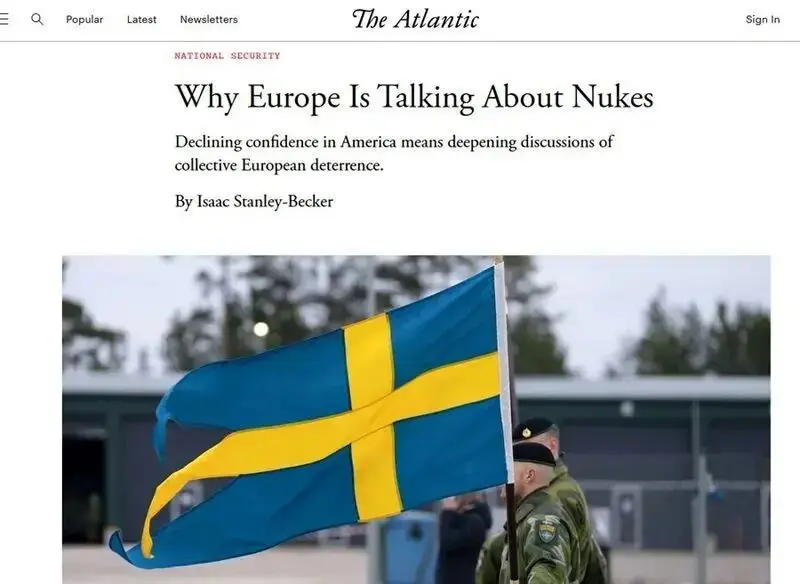
Sweden has not entered any war since 1814 and remained neutral during both World Wars. In the 1970s and 1980s, it had one of Europe’s most prominent and politically powerful anti-nuclear movements. And only two years ago did it join NATO, following Russia’s full-scale invasion of Ukraine. Therefore, it was notable that last month Kristersson acknowledged in an interview with Swedish state television that preliminary discussions had been held with Europe’s nuclear powers.
He then noted that Britain’s nuclear forces are integrated into NATO’s nuclear planning mechanisms, while France’s are not: “We are now engaged in ongoing talks with France and Britain.”
He pointed out that Britain’s nuclear forces are integrated into NATO’s nuclear planning structures, whereas France’s are not: “They are not yet very precise, and the French are exclusively French, but France has also shown readiness to engage in dialogue with other countries.”
Speaking today, the Prime Minister tempered his remarks with cautions he said were necessary due to the risk of what he called “exaggerated interpretations,” which arise whenever the nuclear issue is raised. Kristersson said that, at present, “the American nuclear umbrella is completely dominant.” He has seen no sign that Washington intends to limit it, even as the Trump administration pressures European countries to take greater responsibility for their own defense. Nevertheless, the Prime Minister said, it is “a good thing” that European countries with such capabilities (nuclear capability) exist.
Possessing such capabilities is one matter. But there is now a new commitment to use them for common defense. Last summer, the leaders of Britain and France announced for the first time that they would coordinate their nuclear planning and pledged to respond jointly in the event of a severe threat to Europe.
Friedrich Merz, the Chancellor of Germany, said today in his speech at the Munich Security Conference that he is negotiating with Emmanuel Macron, the President of France, regarding the possibility of establishing a collective European nuclear deterrent, and declared that U.S. leadership “has been challenged, perhaps even lost.” The German Chancellor added that the rules-based international order “no longer exists.”
One of the rules upon which that order was built has recently disappeared: the New START treaty, the last major nuclear arms control agreement between the United States and Russia, expired this month. Even as the Trump administration seeks to shift responsibility for Europe’s defense away from itself, its envoys appear unenthusiastic about Europe’s new discussions on nuclear weapons.
Elbridge Colby, U.S. Under Secretary of Defense for Policy, told the audience in Munich today that Washington does not support the “friendly spread of nuclear weapons.” He confirmed yesterday in remarks to NATO defense ministers: “We will continue to provide extended U.S. nuclear deterrence.”
However, as Washington continuously insults and bullies its European allies and threatens to seize allied sovereign territory, its commitment is becoming less valuable. Declining trust in the United States has generated its own pan-European vocabulary. Germans use the word Vertrauensverlust, or “loss of trust.” Kristersson taught me the Swedish equivalent: förtroendeskadligt, or “damaging to trust.”
The Swedish Prime Minister said: “We have not fallen apart, but we are watching carefully and listening, aware of the fact that we could suddenly be surprised, and we do not like that.” “That is what it means.”
The security provided by the United States had guaranteed Sweden’s pacifism. The Swedish Prime Minister said: “We became strongly opposed to nuclear weapons.” But given that a nuclear-armed Russia is seeking to swallow a neighbor, he expressed a more realistic view: “As long as bad powers have nuclear weapons, democracies must also be in this game.”
Kristersson predicted that the outcome of Russia’s war in Ukraine will help determine how Europe approaches the nuclear issue. The more favorable the outcome is for Russia, the more compelling the case for increased nuclear deterrence becomes. He noted that history is instructive: Ukraine gave up the nuclear weapons it inherited after the collapse of the Soviet Union in exchange for security guarantees from Russia, the United States, and others. Those guarantees proved meaningless.
Kristersson made clear that his discussions do not concern domestic weapons of the kind his country pursued after World War II. In 1957, the CIA assessed that Sweden “has a sufficiently developed reactor program to enable it to produce some nuclear weapons within the next five years.”
The United States demanded the abandonment of that program and reassured Sweden regarding its nuclear umbrella. The government in Stockholm signed the Nuclear Non-Proliferation Treaty in 1968 and shut down its plutonium laboratory in 1972.
Today, the Prime Minister emphasizes Sweden’s ability to benefit from the nuclear capabilities of what he called “friendly powers.” However, when I asked whether he could rule out the kind of nuclear proliferation that Sweden nearly pursued after World War II before changing course, he replied: “Can I rule it out forever? Of course I cannot.”