

Foreign Minister’s Speech at “Al Jazeera Forum 2026”; Araghchi’s Warning:
If the World Wants Peace, It Must Stop Rewarding Aggression
Rokna Political Desk: Iran’s Foreign Minister emphasized at the Al Jazeera Forum that the doctrine of immunity not only fails to guarantee peace but also intensifies violence and regional conflicts. Justice for Palestine and the end of occupation, he added, are the only paths to sustainable stability.
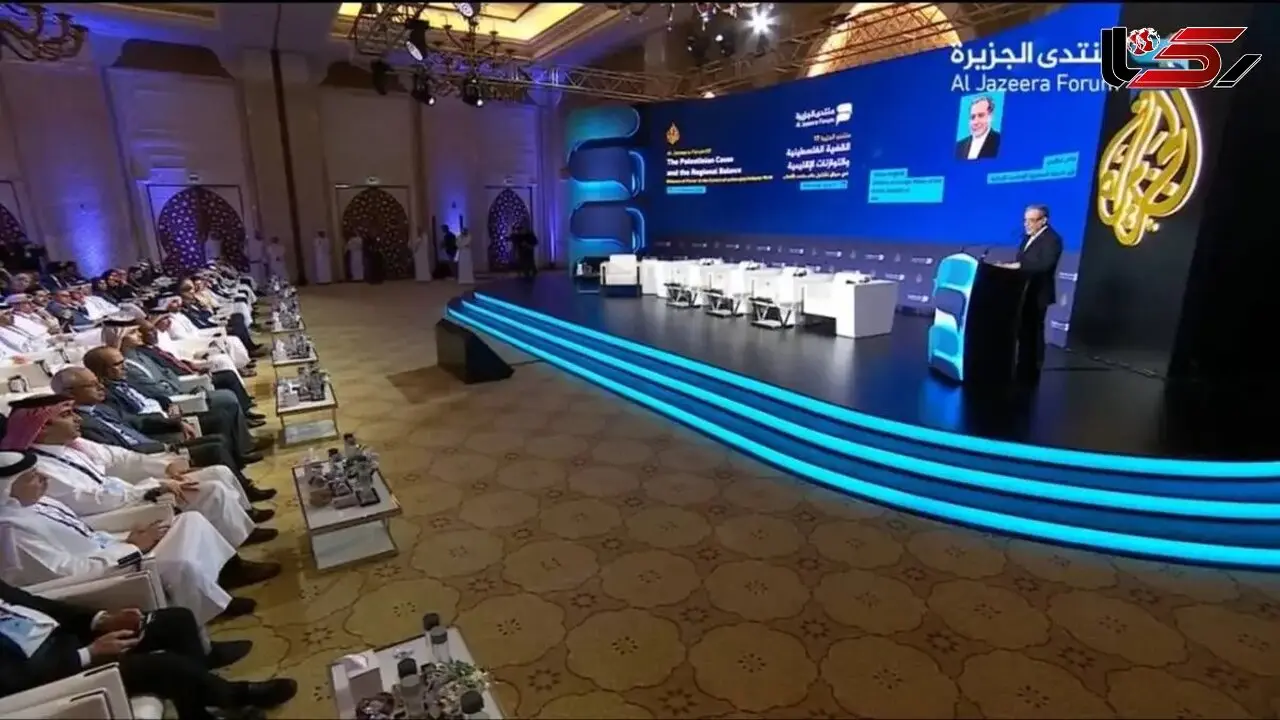
According to Rokna, Seyed Abbas Araghchi, Iran’s Foreign Minister, traveled to Qatar yesterday evening following the conclusion of a new round of Iran-U.S. talks in Oman, to attend the Al Jazeera Forum. He delivered a speech as a special guest at the opening panel of the 2026 Al Jazeera Forum.
The text of the Foreign Minister’s speech is as follows:
“It is an honor to speak at this distinguished forum and to address a fundamental question concerning our region: Palestine.
Allow me to begin with a reality that our region has painfully learned over decades, and today the world is once again learning at a tremendous human cost:
‘Palestine is not one among many issues.’
Palestine is the defining question of justice in West Asia and beyond. Palestine is our region’s strategic and moral compass. It is a test of whether international law has meaning, whether human rights have universal value, and whether global institutions exist to protect the vulnerable—or merely to justify the power of the strong.
Palestine and Gaza are not merely a humanitarian crisis. They have become a platform for something larger and far more dangerous: an expansionist project pursued under the banner of ‘security.’ For generations, the Palestinian crisis was primarily understood as the consequence of illegal occupation and the denial of an inalienable right: a people’s right to self-determination. Today, however, we must recognize that this crisis has far surpassed the framework of mere occupation. What we witness in Gaza today is not simply a war. It is not a ‘conflict’ between equals. It is not an unintended consequence of security measures. This is the deliberate and widespread destruction of civilian life. This is genocide.
The human cost of Israel’s crimes in Gaza has wounded the conscience of humanity. It has pierced the heart of the Islamic world and simultaneously shaken millions beyond it: Christians, Jews, and followers of all faiths who still believe that a child’s life is not a bargaining chip, hunger is not a weapon, hospitals are not battlefields, and killing families does not constitute legitimate defense.
Palestine today is not merely a tragedy; it is a mirror held up to the world. A mirror reflecting not only the suffering of the Palestinians but also the moral failure of those who had the power to prevent this disaster yet instead justified it, enabled it, or normalized it.
Palestine and Gaza are not merely a humanitarian crisis; they have become a platform for something larger and more dangerous: an expansionist project under the guise of ‘security.’
This project has three consequences, each profound and concerning:
The first consequence is global. The behavior of the Israeli regime in Palestine and the immunity granted to it has severely undermined the international legal order. We must state clearly: the world is heading toward a situation where international law is no longer respected and does not govern international relations.
Perhaps most dangerous is the precedent being set: that if a state enjoys sufficient political cover and support, it can bomb civilians, besiege populations, target infrastructure, carry out cross-border assassinations, and still demand to be considered lawful.
This is not merely a Palestinian problem; it is a global problem. We are witnessing not only the tragedy of Palestine but also the transformation of the world into a place where law yields to force.
The second consequence is regional. Israel’s expansionist project has a direct and destabilizing effect on the security of all countries in the region.
The Israeli regime now openly violates borders. It disregards sovereignty. It assassinates officials. It carries out terrorist operations. It expands its influence across various domains. And it does so not covertly, but with a sense of entitlement, having learned that international accountability will not follow.
Let us speak plainly: if the Gaza issue is ‘resolved’ through destruction and forced displacement—if this pattern is accepted—the West Bank will be next. Annexation will become official policy. This is the essence of what has long been called the ‘Greater Israel project.’
Therefore, the question is not whether Israel’s actions threaten only the Palestinians; the question is whether the region will accept a future in which borders are temporary, sovereignty conditional, and security defined not by law or diplomacy but by the ambitions of a military occupier.
The third consequence is structural—and perhaps the most dangerous. Israel’s expansionist project requires the weakening of neighboring countries—militarily, technologically, economically, and socially—so that Israel permanently maintains superiority. Within this framework, Israel is free to expand its military arsenal without restriction, including weapons of mass destruction beyond any inspection regime.
Meanwhile, other countries are asked to disarm. Some are pressured to reduce their defense capabilities. Some are penalized for scientific advancement. Some are sanctioned for building resilience.
Let no one be mistaken: this is not arms control. This is not non-proliferation. This is not security. It is the imposition of permanent inequality: Israel must enjoy ‘military, intelligence, and strategic superiority’ while others remain vulnerable. This is the doctrine of domination.
Ladies and gentlemen,
This is why the issue of Palestine is not merely a humanitarian matter; it is a strategic one. It is not just about Gaza and the West Bank; it is about the future of our region and the rules governing the world.
So what must be done?
Expressing concern is not enough. Issuing statements is not enough. Mourning is not enough. We need a coordinated strategy for action—legal, diplomatic, economic, and security-oriented—rooted in the principles of international law and collective responsibility.
First, the international community must unequivocally support legal mechanisms.
Second, violations must have consequences.
We demand comprehensive and targeted sanctions against Israel, including immediate arms embargoes, suspension of military and intelligence cooperation, restrictions on officials, and trade prohibitions.
Let no one miscalculate: no region can remain stable if one actor is allowed to operate above the law. The doctrine of immunity does not bring peace; it leads to wider conflict.
Third, we need a legitimate, law-based political horizon. The international community must emphasize: ending the occupation, the right of return and compensation in accordance with international law, and the establishment of an independent and united Palestinian state with Jerusalem as its capital.
Fourth, the humanitarian crisis must be recognized as an urgent international responsibility. Collective punishment must never be normalized.
Fifth, regional countries must act in a coordinated manner to protect sovereignty and deter aggression. The principle must be clear: security cannot be built on the insecurity of others.
Finally, the Islamic world, the Arab world, and Global South countries must form a unified diplomatic front. The Organization of Islamic Cooperation, the Arab League, and regional bodies must move beyond symbolism toward coordinated action: legal support, diplomatic initiatives, economic measures, and strategic messaging. This is not about confrontation; it is about preventing the region from being redrawn by force.
Colleagues,
Let no one miscalculate: no region will remain stable if one actor is allowed to operate above the law. The doctrine of immunity does not bring peace; it leads to broader conflict. The path to stability is clear: justice for Palestine, accountability for crimes, the end of occupation and apartheid, and a regional order based on sovereignty, equality, and cooperation.
If the world wants peace, it must stop rewarding aggression. If the world wants stability, it must cease supporting expansionism. If the world believes in international law, it must enforce it—equally and without double standards. If the peoples of this region desire a future free of endless wars, they must accept this fundamental truth: Palestine is not merely a symbol of solidarity; it is the essential cornerstone of regional security.”