

Trump announces ‘complete blockade’ of sanctioned oil tankers to Venezuela
Rokna Political Desk: In a post on Truth Social, President Donald Trump also designated the government of President Nicolás Maduro as a foreign terrorist organization.
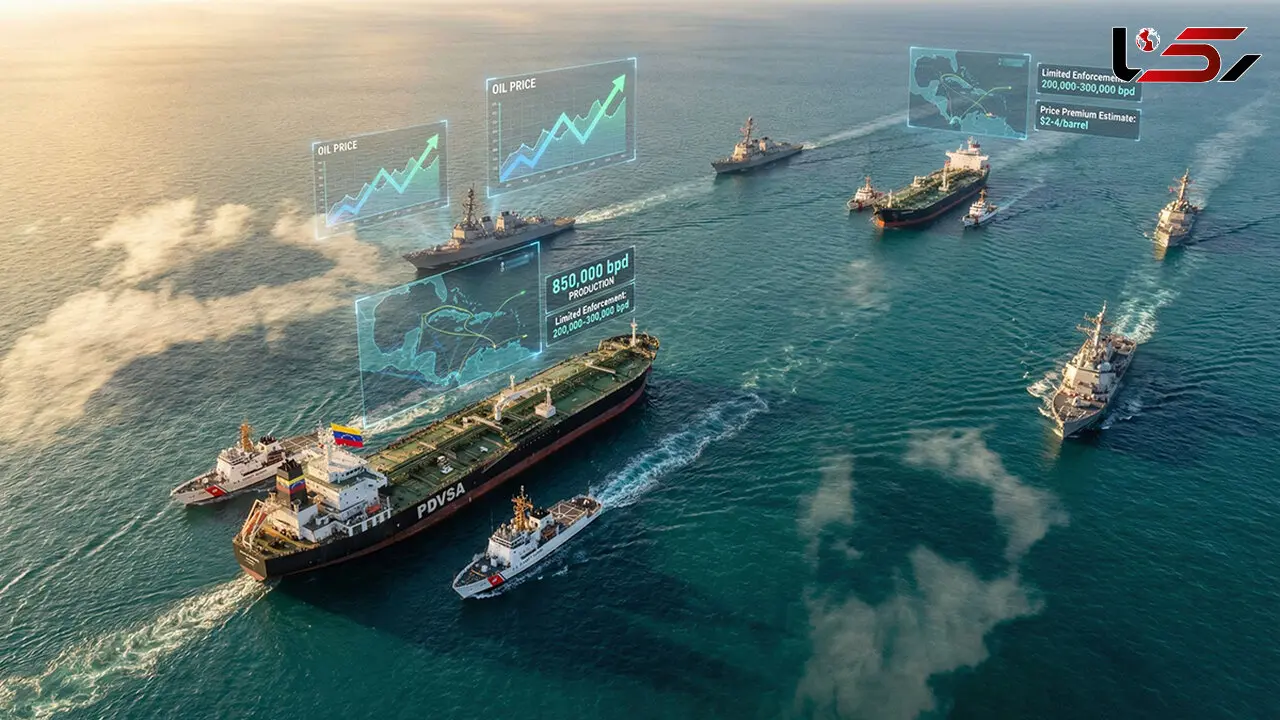
Accoording to Rokna, citing The Washingtom Postt, President Donald Trump on Tuesday ordered what he described as a “total and complete blockade” of all sanctioned oil tankers entering or departing Venezuela, marking a sharp escalation in his months-long pressure campaign against the government of President Nicolás Maduro.
The blockade, announced by Trump Tuesday evening on Truth Social, could severely damage Venezuela’s already fragile economy, which relies heavily on overseas oil exports, mainly to China and frequently transported by sanctioned vessels.
“Venezuela is fully encircled by the largest Armada ever assembled in the history of South America,” Trump wrote. “It will only grow larger, and the shock they experience will be unlike anything they have ever seen — until they return to the United States of America all of the oil, land, and other assets they previously stole from us.”
Trump further labeled the Venezuelan “regime” a foreign terrorist organization (FTO), accusing government officials of using oil revenues to enrich themselves and to fund narcotics-related terrorism.
The move intensifies pressure on Venezuela as the United States seeks to force Maduro from power and continues to threaten military action should he refuse to step aside.
Last week, U.S. forces operating in the Caribbean seized a sanctioned oil tanker shortly after it departed Venezuela. Since September, the U.S. military has also carried out airstrikes on roughly two dozen small vessels allegedly involved in drug trafficking from Venezuela.
A person familiar with the matter, speaking on condition of anonymity due to lack of authorization to comment publicly, said a high-level meeting scheduled for Wednesday could lead to new operational directives for U.S. naval and air forces positioned in the Caribbean. The source said more aggressive U.S. naval actions are expected in the coming days.
In a statement shared on social media by Vice President Delcy Rodríguez, the Maduro government condemned Trump’s announcement as “grotesque” and “war-mongering threats,” pledging to raise the issue before the United Nations as a violation of international law.
Oil market analysts and former U.S. officials questioned both the legal foundation and policy rationale behind Trump’s declaration, which was delivered in his customary combative language and heavy use of capital letters.
It remained unclear whether Trump intended to designate a new foreign terrorist organization or was referring to the previously named Cartel de los Soles, which U.S. authorities allege is led by Maduro and other senior Venezuelan officials. The White House declined to comment.
If Trump does intend to formally designate the Maduro government as a foreign terrorist organization — a legal step typically undertaken by the State Department rather than the White House — Venezuela would become the first country ever to receive such a designation. Venezuela’s government is already subject to a comprehensive U.S. blockade imposed during Trump’s first term, which bars U.S. individuals and entities from conducting business with it.
Other nations, including Iran and North Korea, face similar restrictions, though none has been labeled a terrorist organization. “The key difference with an FTO designation is the extraterritorial reach of U.S. law, even in cases with no direct U.S. connection,” said Jeremy Paner, a former lead investigator with the Treasury Department’s Office of Foreign Assets Control and now a sanctions specialist at Hughes Hubbard & Reed.
Under such a designation, Paner said, “any individual or company providing any form of assistance to the government could potentially be detained.” In theory, this could include executives from Chevron, which produces and exports Venezuelan oil in cooperation with the state-owned PDVSA under a Treasury license.
Trump also introduced a new justification for his actions against Venezuela — beyond allegations of “terrorism, drug trafficking, and human trafficking” — placing primary emphasis on what he described as U.S. assets stolen by Venezuela and demanding their immediate return.
The claim appears to reference Venezuela’s nationalization of its oil industry, a policy adopted by several oil-producing countries, including Saudi Arabia and Mexico. In Venezuela, the nationalization occurred nearly two decades ago under former President Hugo Chávez.
“Venezuela’s natural resources were never the property of the United States,” said David Goldwyn, president of Goldwyn Global Strategies. “Although expropriation claims have been arbitrated internationally, there is no factual basis for asserting that Venezuela stole oil from the U.S.”
Chevron spokesperson Bill Turenne said Tuesday night that the company’s operations in Venezuela continue “without interruption and in full compliance with applicable laws, regulations, and U.S. sanctions frameworks.”
Comprehensive blockades of sovereign states are prohibited under international law. As described by Trump, the blockade would apply only to oil tankers belonging to the so-called “dark fleet” that are already sanctioned by the United States.
“A naval blockade is undeniably an act of war — one that Congress has never authorized and the American people do not support,” said Rep. Joaquin Castro (D-Texas) in a social media post following Trump’s announcement. Castro is a co-sponsor of a bipartisan House resolution directing the president to end hostilities with Venezuela, which is expected to be voted on Thursday.
Last week, U.S. authorities seized an oil tanker off Venezuela’s coast carrying crude from PDVSA. The tanker had been sanctioned in 2022 over allegations it transported illicit Iranian oil.
On Monday, U.S. forces killed eight suspected drug traffickers during three maritime strikes in the eastern Pacific, raising the total death toll in what officials describe as a counter-narcotics campaign to at least 95.
Venezuela’s Foreign Ministry sent a letter to the U.N. Security Council on Tuesday, denouncing the tanker seizure as an “act of state piracy.”
According to Francisco J. Monaldi, director of the Latin America Energy Program at Rice University, the impact of Trump’s blockade will largely depend on how strictly it is enforced.
Many vessels transporting Venezuelan oil to China’s black market are already sanctioned, Monaldi noted. However, oil-tracking firm TankerTrackers.com estimates that only 40 percent of the active dark fleet serving Venezuela is currently under U.S. sanctions. Additional vessels could still be targeted, as occurred last week.
If all sanctioned tankers are effectively blocked, Monaldi said the impact on government revenue could be “enormous,” since roughly 80 percent of Venezuela’s oil is sold through illicit channels. Oil accounts for more than 90 percent of the country’s exports and over half of its fiscal income.
Such a blockade could trigger economic contraction, higher inflation, currency devaluation, and eventually impair oil production capacity, Monaldi added.
Francisco Rodríguez, a Venezuelan economist at the University of Denver, warned that “in practical terms, this amounts to a full naval blockade of Venezuela. Eliminating oil revenues would drastically reduce food imports and could provoke the first major famine in the Western Hemisphere in modern times.”
Venezuela possesses the world’s largest proven oil reserves, but years of mismanagement, deteriorating infrastructure, and U.S.-led sanctions have sharply reduced production. Its main buyers are now China and the United States, where Chevron exports oil produced in Venezuela.