

US aircraft carrier downs Iranian drone as tensions rise and diplomatic talks falter
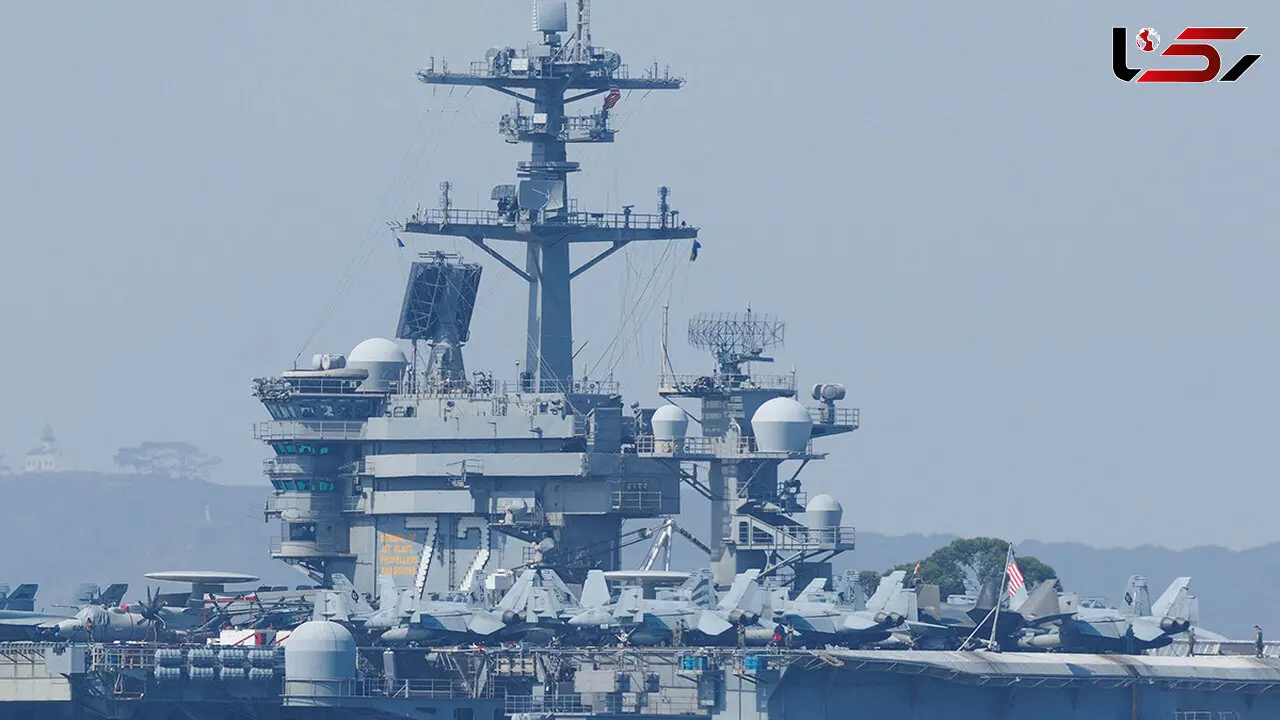
Rokna Political Desk: A US aircraft carrier shot down an Iranian drone that “aggressively approached” the vessel in the Arabian Sea on Tuesday, just hours before two gunboats operated by Iran’s Islamic Revolutionary Guard Corps (IRGC) moved toward a US-flagged tanker in the Strait of Hormuz and threatened to board and seize it, according to a US military official.
According to Rokna, citing CNN, the incidents took place only days ahead of scheduled diplomatic talks between US and Iranian officials on Friday, aimed at preventing a potential military confrontation.
In the first incident, US forces destroyed an Iranian drone after it “aggressively approached” the USS Abraham Lincoln aircraft carrier while the ship was transiting the Arabian Sea roughly 500 miles from Iran’s southern coastline, said Captain Tim Hawkins, a spokesperson for US Central Command.
“The Iranian drone continued flying toward the ship despite de-escalation measures taken by US forces operating in international waters,” Hawkins said. An F-35C fighter jet launched from the Abraham Lincoln shot down the unmanned aircraft to safeguard the carrier and its crew, he added.
“No American service members were injured, and no US equipment was damaged,” Hawkins said.
Iran’s state-affiliated Tasnim News Agency also reported on Tuesday that Iran had lost contact with an IRGC drone during what it described as a “reconnaissance, surveillance and filming” mission over international waters in the Arabian Sea.
According to the agency, the drone had “successfully transmitted its surveillance and reconnaissance footage” to operators at an IRGC command center before contact was lost. An informed Iranian source said the cause of the incident was under investigation and that further details would be released once confirmed.
Several hours later, two Iranian gunboats approached the M/V Stena Imperative, a US-operated chemical tanker sailing under the American flag in the Strait of Hormuz, Hawkins said. The vessels passed the tanker three times at high speed, while an Iranian Mohajer drone flew overhead. During one of the passes, Iranian forces issued a radio threat indicating they intended to board and seize the ship. The tanker was operating in international waters.
US military forces in the region responded after learning of the threats. The USS McFaul destroyer escorted the tanker away from the area, supported by defensive air cover from the US Air Force, Hawkins said. The situation subsequently de-escalated.
Hawkins described the Iranian actions as “unprofessional and aggressive behavior” that heightens the risk of miscalculation for vessels operating in the region, adding that such “harassment” in international waters would not be tolerated by the United States.
The incidents occurred as President Donald Trump has been weighing the possibility of a major military strike against Iran amid ongoing discussions aimed at limiting Tehran’s nuclear program and ballistic missile development.
Diplomatic talks scheduled for later this week encountered difficulties on Tuesday after Tehran requested that the venue be changed, regional participants excluded, and the scope of discussions restricted solely to Iran’s nuclear program, according to three sources familiar with the matter.
White House press secretary Karoline Leavitt said on Tuesday that the meetings, led on the US side by special envoy Steve Witkoff, were “still scheduled at this time,” but emphasized that “the president always has a range of options on the table, including the use of military force.”
Over the past week, the US military has accelerated its buildup of forces in the Middle East, deploying the Abraham Lincoln Carrier Strike Group along with three guided-missile destroyers and its carrier air wing. The air wing includes F/A-18E Super Hornet fighters, F-35C Lightning II jets, and EA-18G Growler electronic warfare aircraft.
Separately, the US Navy has three additional destroyers in the region — the USS McFaul, USS Delbert D. Black, and USS Mitscher.
Iran’s new conditions could complicate efforts by US allies in the Middle East to mediate a diplomatic solution to soaring regional tensions. The talks had originally been scheduled to take place in Istanbul, with foreign ministers from Egypt, Oman, Pakistan, Qatar, Saudi Arabia and the United Arab Emirates expected to attend.
Tehran is now seeking to move the talks to Oman, the Gulf sultanate that has previously hosted US-Iran negotiations, and has asked that discussions be limited to the nuclear issue. Washington has said its demands extend beyond Iran’s nuclear program to include curbing ballistic missile development and ending support for regional proxy groups.
The implications of these proposed changes — first reported by Axios — remain unclear. Some US officials have privately warned that Iran may be using diplomacy to delay or avert military action.
The two principal US participants in the talks, Witkoff and Jared Kushner, President Trump’s son-in-law, arrived in the region on Tuesday for meetings with Israeli officials.
Trump said on Monday that negotiations were ongoing but pointed to the significant US military presence in the region as evidence of his readiness to authorize strikes if talks fail.
“We’re talking to them right now. We’re talking to Iran, and if we can reach an agreement, that would be great,” he said. “If we can’t, then probably very bad things will happen.”
Send Comments