

Controversial Game by Trump with the Trigger and Diplomacy:
Iran Views the USS Abraham Lincoln as a Vulnerable Target
Rokna Political Desk: Trump’s controversial game with the “trigger” and diplomacy has pushed Iran–US relations into a war-or-peace duality; can Tehran find a way to maintain balance in the face of Trump’s policy of increasing strategic disorder?
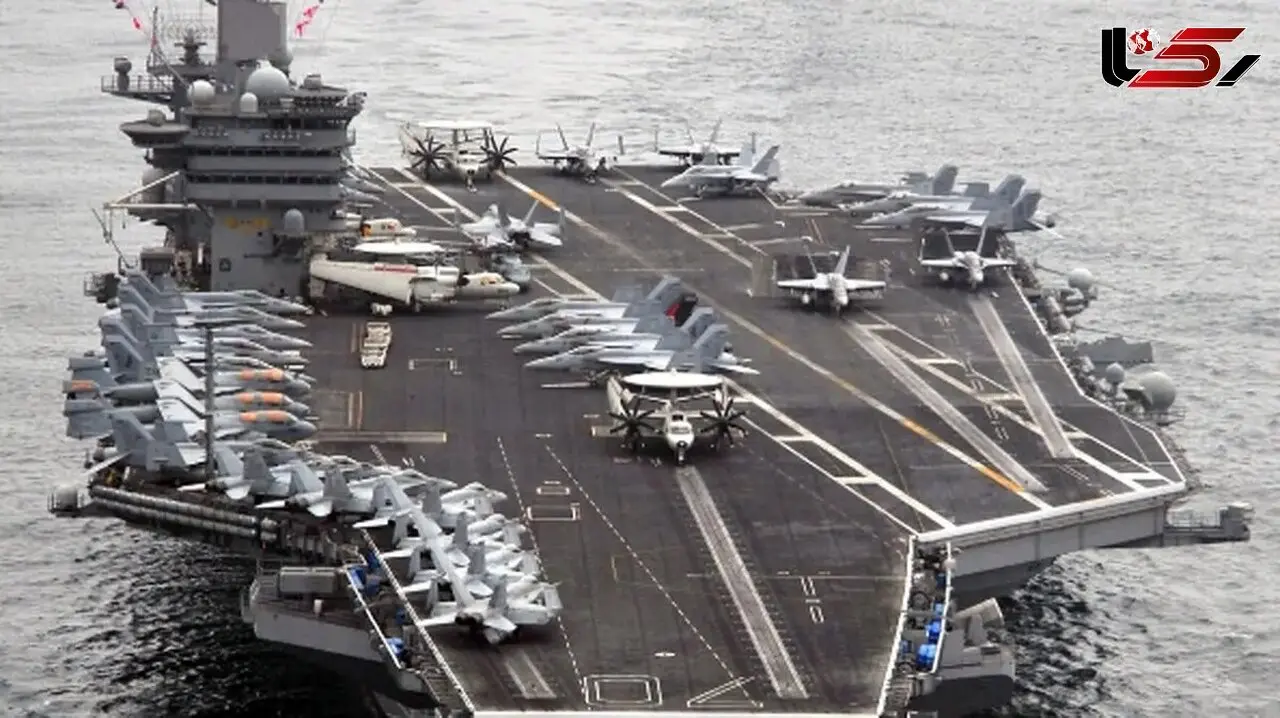
According to Rokna, the game played by the President of the United States with the “trigger” and “diplomacy” on the deck of the USS Abraham Lincoln has turned into a complex gamble on barrels of gunpowder. Tehran is sending balanced signals of “war and peace,” a situation that must be examined and analyzed based on the doctrine of balance. Will Donald Trump ultimately issue the order to open fire, or will he eventually accept a deal with Iran? The bigger question is what scenarios may unfold if war breaks out.
Iran’s deterrence at zero point – Beyond Iran’s defensive arrangements, we are officially witnessing a meaningful shift in the deployment of Iran’s armed forces. At this moment, Iran’s deterrence has been upgraded from the missile layer to the layer of “systemic security.” By activating new protocols in the nuclear domain, Tehran has conveyed to the Pentagon that any “hard confrontation” would immediately shift Iran’s defensive doctrine from a classical posture to an “emergency breakout” status. In fact, Iran views the Lincoln not as a threat, but as a “vulnerable target.” Turning a one-billion-dollar asset into a “geopolitical hostage” in the Strait of Hormuz is precisely where Trump’s commercial realism calculations become disrupted.
The behavioral driving engine of the madman – Amid the media frenzy over potential scenarios, a lack of understanding of Trump’s cognitive and behavioral model weighs heavily. The behavior of the US president is shaped by three main pillars: the madman theory, offensive realism, and engineered entropy.
A – The Madman: The concept of the “Madman Theory,” used in foreign policy, refers to a strategy in which a leader portrays himself as unpredictable and beyond control. Nixon used this concept to intimidate, bargain, and reach understandings with US adversaries. The madman theory is based on the assumption that a leader who exhibits abnormal and unpredictable behavior can force other global actors to grant concessions they would not normally offer.
Trump likes to appear unpredictably harsh to both friends and enemies. When it seems he is moving toward a “deal,” he suddenly declares war; and when calculations suggest the likelihood of confrontation is high, he shifts toward a “deal.” He raises the cost of opposing Washington’s demands so high that the other side views negotiation not as an option, but as a “necessity for survival.” The US president clearly seeks to create cognitive chaos in the mind of the target so that a “deal” appears as the only escape route.
When Trump sends contradictory signals—one day threatening destruction and the next day calling for negotiations—his aim is to create “strategic vertigo” in Tehran. In decision-making science, if a system’s inputs are excessively contradictory and chaotic, the system suffers from “analysis paralysis.” When an adversary cannot predict your next move, it is forced to prepare for all scenarios—from war to peace. This comprehensive readiness drains the adversary’s resources and mental capacity, placing it in a “computational deadlock.”
B – Offensive realism: In classical terms, a large portion of what the United States pursues in foreign policy is rooted in offensive realism. In some cases, Trump follows the ideas of Henry Kissinger, the godfather of US foreign policy. In this framework, unlike defensive realism which seeks to preserve the status quo, the ultimate goal is the maximization of power to achieve hegemonic status. Offensive realism assumes that the international system is anarchic and that no authority stands above states.
Trump uses military power as a tool to guarantee survival through dominance. The US president believes that contemporary US policies tied to international relations norms have harmed American interests. Trump is now rapidly employing “gunboat diplomacy.” He does not send the aircraft carrier to the Persian Gulf to fight—because war is costly and drains national wealth—but rather to alter the “distribution of power” at the negotiating table. Nevertheless, war scenarios also appear plausible. In Washington’s deeper perspective, every dollar earned by Iran or China is one dollar deducted from America’s relative power. At the same time, Iran’s presence within the “revisionist coalition” is considered an undesirable condition.
Based on offensive realism, Trump seeks to turn Iran into a piece that no longer poses a “threat to US hegemony.” Mearsheimer warns that offensive realism can lead to a “security trap”: when the US increases power for its own security, Iran also shifts its nuclear doctrine for its security, and this spiral can result in a systemic explosion.
C – Disorder based on order: Trump believes that entrenched cases such as Iran cannot be resolved in stable environments; therefore, by creating entropy, he prepares the ground for a “new configuration.” He dismantles the existing order—such as the JCPOA or traditional agreements—to push the system toward collapse. In physics, entropy is the natural tendency of systems toward disorder; in Trump’s doctrine, however, entropy is an “engineered tool.” In the Iran case, Trump deliberately seeks to increase entropy—strategic disorder—to place Tehran in a computational deadlock. Trump himself is the “entropy agent”; he disrupts the existing order so that a new order of his choosing—a deal—can emerge from the chaos.
The US president believes that to move a large boulder, one should not push it, but rather place dynamite beneath it. The greatest miscalculation is to assume Trump is genuinely “crazy,” when in fact this “madness” is part of a mathematical algorithm for risk management and maximizing gains at the negotiating table. In game theory, if you are entirely rational, your opponent can calculate your logic and outmaneuver you; but if the opponent believes you might act irrationally, it will not accept the risk of confrontation.
With an understanding of Trump’s intellectual triangle, a clearer picture of “engineered chaos” emerges. In the US president’s mind, disorder is not a byproduct, but the “raw material” for power reconfiguration. In game theory, a threat is effective only if it is “credible.” Trump increases the credibility of his threats through entropy.
Stability versus chaos – “Disorder based on order” means Trump is a “strategic disrupter.” He does not send the Lincoln to the Persian Gulf to establish order; he sends it to render the existing order “obsolete.” He aims to place Tehran in a position of “absolute uncertainty” through entropy. The key point is that, according to game theory, the side that can manage “ambiguity” will win the field.
In the immediate term, “defensive realism” based on “strategic patience” and “reciprocal entropy” can regain maneuvering power against the US military alignment. An absolute “yes” or absolute “no” is what Trump desires, whereas “ambiguity” frustrates the US president. The combination of “war and peace” and movement toward “Iranian entropy” is a complex process that, paradoxically, enables reaching a deal from a position of strength.
Multilateralism with Eastern powers and security convergence are special processes that increase the cost of US behavior in parallel with field pressure. At the same time, Trump has shown a strong inclination toward “back-channel diplomacy,” and contrary to media headlines, the possibility of a “hidden transaction” between Tehran and Washington is emerging. The correct path for Tehran is “diplomacy from a position of absolute deterrence.” The boomerang effect of Trump’s entropy and US concerns over geopolitical fault lines may, at the boiling point, prevent a major confrontation.
Possible scenarios – Probabilities and scenarios regarding Iran and the US fluctuate moment by moment around the possibility of war or peace. The situation is so fluid that scenarios undergo “operational metamorphosis.” In a broad assessment of recent reports from think tanks such as CSIS, the Atlantic Council, and the Washington Institute, we are witnessing a complex process.
1 – Possibility of an emergency agreement in the gray zone: There is a scenario in which the US president suddenly announces, officially, an agreement before a deadline. Under this scenario, neither an agreement is signed nor a shot fired, but a kind of “unwritten ceasefire” is established so that Trump can claim victory in the media showcase while Iran regains access to its blocked financial resources.
This scenario aligns with Trump’s desire for a “quick win” without conflict. Based on the “neither JCPOA nor war” mechanism, an unofficial temporary arrangement emerges in which Iran “freezes” high-level enrichment and regional activities, while Trump conditionally suspends part of the oil and banking sanctions through an “executive order.” It should be noted, however, that the continuation of a “red status” without agreement is also possible. The US would permanently station carriers in the region and raise “economic siege” to 100 percent, while Iran, in response, would tilt its deterrence doctrine toward the “nuclear breakout point.”
2 – Possibility of limited confrontation: While concerned about the costs of war, Trump has a “provocative” inclination to use US military power. The mechanism of limited confrontation would involve strikes on one or two symbolic centers or energy export infrastructure within a 72-hour window. The explicit goal of such an attack is not regime change or full-scale war, but a “system shock” to force Tehran to accept new conditions.
There is a mindset in the Pentagon that Tehran’s response would be “proportionate” rather than “devastating,” but the issue is that Trump is gambling on Iran’s reaction model. Iran has signaled that it does not recognize the concept of a “limited strike” and that its response would be “asymmetric and extensive.” The other side also knows that Tehran possesses strike capability.
3 – Possibility of hard and widespread confrontation: The possibility of US involvement and a repeat of the Iraq scenario appears high on paper, but in immediate terms is “irrational.” In strategic realism, we distinguish between “military attack” and “full-scale war.”
Trump has built his strategy on “successful extortion,” not “futile cost-generation.” He uses the Lincoln as “gunboat diplomacy” to push Iran toward the first scenario—a deal—because he himself knows he lacks the financial and military capacity for the third scenario.
A full-scale war with Iran would mean entering an ambiguous situation whose costs would exceed those of the Iraq and Afghanistan wars. Moreover, Washington’s focus is not solely on Tehran; it is also preoccupied with China and Russia. Washington does not want to enter the systemic impact of geopolitical fault lines. Trump likes “military posture” because it is a power tool, but he avoids actual war due to its unpredictable costs.
From war of the century to deal of the century – Trump wants to stand on the edge of the abyss as the “deal-maker of the century,” but Tehran has reminded him that in the Middle East, the price of a deal is set by “blood and oil,” not tweets and tariffs. The international system is witnessing “guided entropy,” where Iran, using the “Russia and China card” and “deep influence,” places the US in a strategic deadlock. Beijing’s and Moscow’s reaction models remain an enigma that could either escalate or contain tensions.
Trump in 2026 is not a president seeking “global order”; he is an offensive realist who wants to destroy order so that, amid the ruins, the only remaining power is “Uncle Sam.” He views the carrier as a “gun on the poker table,” not for firing, but to ensure the opponent knows that if the wrong card is played, the table will be flipped.
The Lincoln may be able to create waves, but it cannot change the course of history in the region. Tehran has shown a “green light” for diplomacy, but its hand remains on the “red button.” Ultimately, it is “economic resilience” and “security intelligence” that will determine whether the Persian Gulf moves toward a “grand understanding” or a “historic explosion."
By: Ali Vadaei
Send Comments