

CEO of the Tehran Province Water and Wastewater Company Announces:
Tehran in the Driest Conditions of the Past 100 Years / The Second Taleqan Line Will Not Save the City
Rokna Economic Desk: The inflow and reserves of the country’s dams have declined sharply compared to last year, and Tehran is experiencing one of the driest years in a century, facing an unprecedented water shortage. Therefore, managing and reducing water consumption is essential. If high consumption continues, restrictions and 24-hour cuts will be imposed on wasteful consumers, while technical projects such as the second Taleqan water line can compensate for only a small portion of Tehran’s needs.
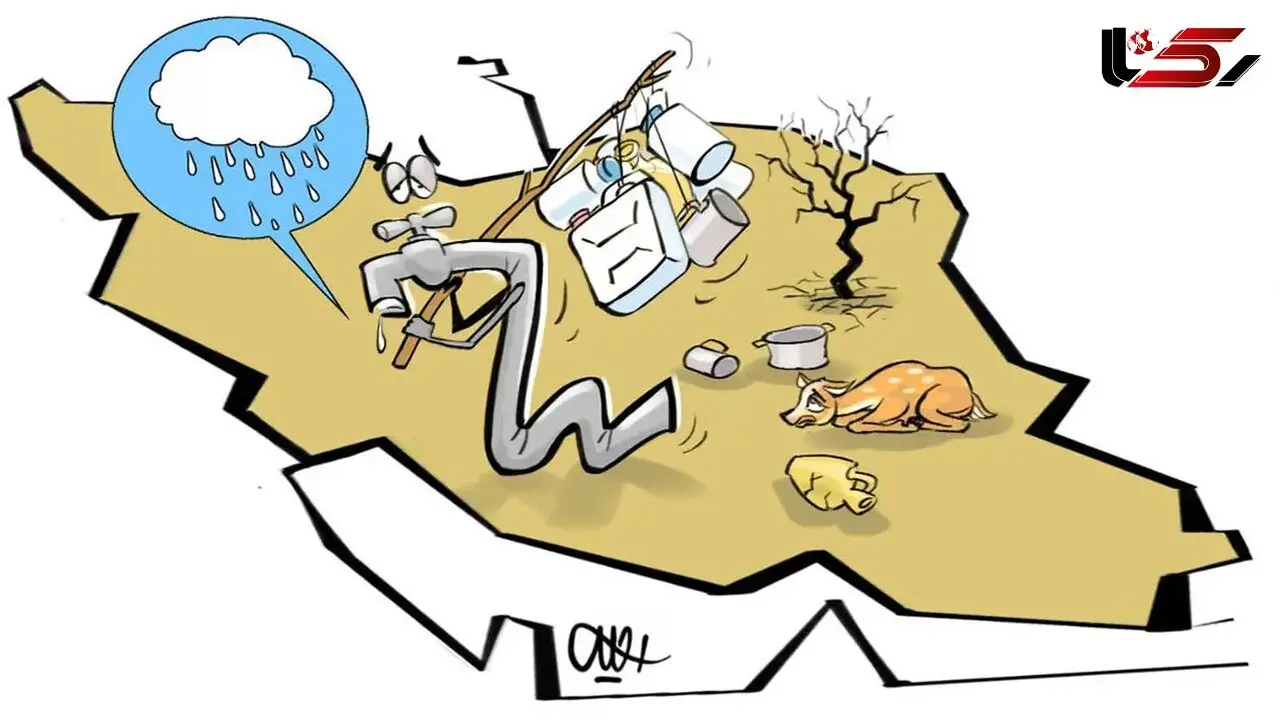
According to Rokna’s economic correspondent, from the beginning of Mehr 1404 until 24 Aban, total water inflow into the country’s dams reached 1.7 billion cubic meters. Compared to the 2.82 billion cubic meters recorded during the same period last year, this represents a 40 percent decrease.
During the same period, approximately 3.4 billion cubic meters of water were released from the country’s dams to meet drinking, agricultural, industrial, and environmental needs. The output from dams during the same period last year was 4.58 billion cubic meters, indicating a 26 percent decline.
According to the latest statistics, the volume of water stored in Iran’s dams has reached 16.95 billion cubic meters, with only 33 percent of reservoir capacity filled, while 67 percent remains empty.
On 24 Aban 1403, national dam storage was reported at 22.75 billion cubic meters. Comparing that figure with the current volume indicates a 26 percent decline in stored water.
Unprecedented Water Shortage in Tehran in the Past 100 Years
According to the Tehran Water and Wastewater Company, Mohsen Ardakani identified consumption management as the company’s top priority for overcoming the current drought and the only path out of Tehran Province’s red-level water crisis.
Ardakani stated that the data indicate the most exceptional water shortage in the province in a century. For the first time in 100 years, Tehran is experiencing five consecutive years of drought, and last water year recorded the lowest rainfall in 60 years with just 159 millimeters.
He added: Furthermore, in the first 55 days of the current water year we have witnessed the driest autumn in Tehran without a single drop of rainfall. These factors have reduced the stored water in Tehran’s four main supplying dams to the lowest level in 60 years.
He noted that it had been predicted that some of Tehran’s dams would be removed from operation by the end of Shahrivar due to water shortages, but due to citizens’ cooperation in reducing consumption by 10 to 12 percent, along with the measures and planning of the Energy Ministry and the Tehran Water and Wastewater Company, this has been delayed. Thanks to public cooperation, 80 million cubic meters—equivalent to the volume of the Latian Dam reservoir—have been saved in withdrawals and consumption.
Ardakani emphasized that although the Meteorological Organization has forecast minimal rainfall for Tehran this week, overcoming the current water shortage requires an additional 10 percent reduction in consumption.
Warning of 24-Hour Water Cuts for Wasteful Consumers
Ardakani thanked citizens for their 10 to 12 percent reduction in water use but noted that per-capita consumption remains high at 185 liters per person per day, far above the recommended standard of 130 liters.
He stated that 34 percent of Tehran households follow the consumption pattern of 12,000 liters per household per month, which fully satisfies sanitation and domestic needs. Therefore, the remaining 66 percent are urged to move toward the standard pattern.
He added: Currently, 61 percent of consumers in Tehran use up to twice the designated consumption limit and are classified as high-consumption, while five percent consume more than twice the limit and are categorized as wasteful. If wasteful consumption continues and warnings are ignored, their water supply will be cut for 24 hours initially and for longer periods in case of repeated violations, and heavy bills will be issued.
The CEO highlighted simple measures that can significantly reduce water usage, naming the installation of consumption-reducing fixtures on faucets as one of the most effective actions. He noted that this simple step can reduce water use by 30 percent and that citizens can request these devices through the 122 hotline and purchase them with one-year installment plans.
He added that using dishwashers and washing machines at full capacity, shortening shower times, turning off taps when not in use, and brushing teeth using one cup of water are among other recommended measures. He stressed that women, as household managers, can play an important role in supporting domestic water conservation programs.
The Second Taleqan Transmission Line Supplies Only One-Eighth of Tehran’s Drinking Water Needs
Ardakani then addressed the Energy Ministry’s and the company’s plans for securing and transferring water to Tehran, stating that with the recent implementation of the second Taleqan water transmission line to Alborz and Tehran Provinces, an additional 5,000 liters per second have been added to Tehran’s water supply capacity. However, this amount covers only one-eighth of the city’s drinking water needs. He added that the cost of desalinating and transferring water from the Persian Gulf coastline to Tehran is at least seven euros per cubic meter—an extremely high and unjustifiable figure—and that currently no such program is being pursued.
He also stated that the water distributed throughout Tehran meets uniform safety and quality standards, adding that water supplied in all areas of the city is 100 percent safe to drink and is tested daily in 38 laboratories through hundreds of analyses, with quality monitored by relevant agencies including the Ministry of Health and the Standards Institute.
Energy Ministry Avoids Water Rationing; Night-Time Pressure Reduction Applied Every Other Night
Ardakani said that the Energy Ministry’s current policy is to avoid any form of water rationing. However, due to low reserves and reduced rainfall, and to ensure the equitable distribution of available resources, maximum reduction of distribution network pressure during night and early-morning hours every other night has been implemented. He added that households equipped with standard pumps and storage tanks of 75 liters per person will not feel pressure shortages, although a 20 percent reduction in consumption remains necessary to pass through current conditions.
Unprecedented Dryness Continues Across 20 Provinces Through Early This Week
New reports from the Iran Water Resources Management Company show that from the beginning of Mehr until Friday, 23 Aban, rainfall across the country has dropped to an unprecedented level, with 20 provinces experiencing absolute dryness and recording zero precipitation.
According to official data, rainfall during the first 53 days of this autumn has totaled only 3.4 millimeters, compared to 22.7 millimeters during the same period last year. This represents an extraordinary 85 percent decrease.
Long-term averages for this period are normally about 23.5 millimeters, meaning that this year’s rainfall is more than 85 percent below the multi-decade average.
Official figures indicate that 20 provinces have received no rainfall since the start of autumn, a situation that experts say has no precedent in the past 60 years. These provinces include Tehran, Markazi, Kermanshah, Khuzestan, Fars, Kerman, Isfahan, Sistan-and-Baluchestan, Kurdistan, Hamedan, Chaharmahal-and-Bakhtiari, Lorestan, Ilam, Kohgiluyeh-and-Boyerahmad, Bushehr, Zanjan, Yazd, Hormozgan, Qom, and South Khorasan.
Although other provinces have experienced minimal rainfall, their conditions remain poor. In Alborz, Qazvin, and Razavi Khorasan Provinces, rainfall decreases of 99, 98, and 95 percent have been recorded compared to last year. Semnan, Ardabil, East Azerbaijan, West Azerbaijan, and North Khorasan have seen decreases of between 84 and 93 percent. Even the northern provinces—normally rainfall leaders in autumn—are experiencing significant declines, with precipitation in Gilan down 59 percent, Mazandaran 57 percent, and Golestan 34 percent compared to long-term averages.
Thus, statistics show that all 31 provinces in the country have faced reduced rainfall this autumn, and national-level precipitation conditions are entirely negative.
Send Comments