

At a Three-Hour Meeting with a Group of Media Managers;
Qalibaf: From the Sixth Day of the 12-Day War, We Struck Wherever We Willed
Rokna Political Desk: Mohammad Bagher Qalibaf said: On the fifth and sixth days of the 12-day war, the enemy became passive because their land and sky were in our hands, and we struck wherever we willed; and it was at this very point that Vance, the Vice President of the United States, began directly pursuing us from the sixth day, saying that they were ready to meet Iran’s foreign minister anywhere, provided that we accept a ceasefire.
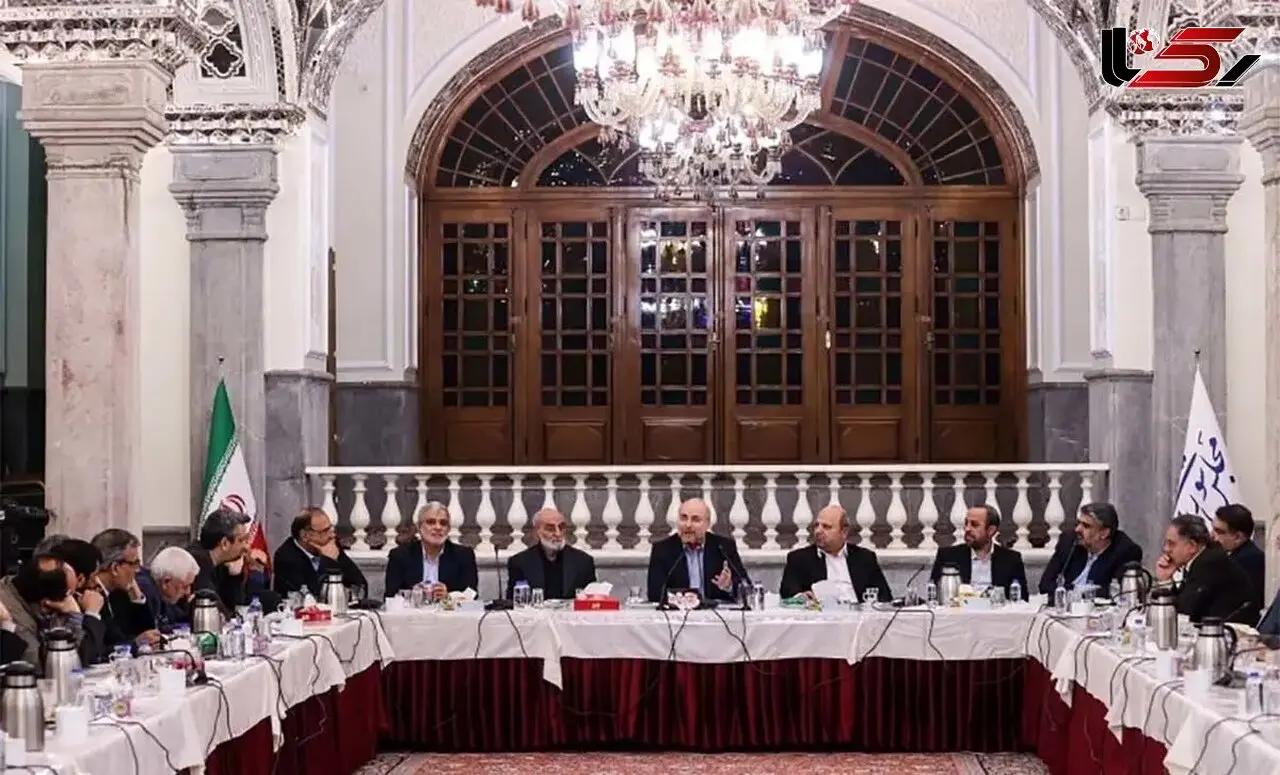
According to Rokna, quoting from the Islamic Consultative Assembly News Agency, a cordial and candid meeting with a large group of the country’s media managers from various political groups was held with Mohammad Bagher Qalibaf, Speaker of the Islamic Consultative Assembly, on Saturday evening (8 Azar 1404), on the eve of Parliament Day.
In this meeting, which lasted more than three hours, about 30 editors-in-chief of the country’s media outlets first expressed their views, criticisms, concerns, suggestions, and questions regarding various issues of the country, including media-related matters. Subsequently, in the final part of the meeting, Mohammad Bagher Qalibaf, referring to a number of points raised by the media managers about the 12-day war, said that we must accept that the conditions before and after the 12-day war are different. He added: The Zionist enemy, with the full support of the current U.S. administration, carried out its actions, but the Iranian people stood up against this conspiracy.
Referring to the Zionist enemy’s movements in the region, including Syria, Lebanon, Iraq, and Qatar, he emphasized: These realities are in front of us, and we must stand against this enemy with power, readiness, and strength.
Qalibaf, recalling details of the 12-day war, added: Once again in my life, I witnessed that the Leader of the Revolution, just as during the Sacred Defense when he was present in the Ahvaz fronts on behalf of Imam Khomeini (RA), was present in the battlefield and war command room, and before 8:00 a.m. on the first day of the enemy’s aggression, all appointed commanders were briefed in person.
The Speaker of the Islamic Consultative Assembly, referring to the bravery of the missile forces during the days of the war and their martyrdom, said: The enemy did not expect us to return with strength, but through the sacrifice and efforts of our fighters, on the fifth and sixth days of the war, we achieved fire superiority over the enemy, and the rate and accuracy of our fire improved day by day — meaning that, just as they were in our airspace, we were in their air and land, and we struck wherever we willed.
Qalibaf, emphasizing that we were engaged with the entire NATO, said: When Trump became the President of the United States in 2016, he received 4 billion dollars from Arab regional countries to create a joint defense system among them. This defense network, aside from the Iron Dome system and NATO defenses and other regional anti-missile systems, was designed for this purpose.
The head of the legislature continued: Under such conditions, in our missile operations, we bypassed NATO and other defense layers; on the first and second days, the number of our drones was equal to the number of their aircraft in the sky, and their aircraft did not even have enough opportunity to land at their own airports, and often landed in another country’s airport and then returned to their own.
He stated: Ultimately, on the fifth and sixth days, they became passive because their land and sky were in our hands, and we struck wherever we willed; and it was at this point that Vance, the Vice President of the United States, directly pursued contact from the sixth day, stating that they were prepared to meet Iran’s foreign minister anywhere, provided that we accept a ceasefire.
Qalibaf, stating that they achieved none of their objectives, said: At one of the ceremonies commemorating Martyr Hassan Tehrani Moghaddam, I said that we absolutely take pride in our missile capabilities, but my belief is that what makes the Islamic Republic of Iran strong, powerful, and enduring is the heart of the Iranian people — not only our missiles. And alongside our missile power, the unity and social cohesion of the people enabled us to experience and taste the victory over the enemy.
He emphasized: I confidently say that our strength, both quantitatively and qualitatively, despite all issues and challenges, is greater than before, because the operational, technical, and tactical experiences we gained in the past year, especially during the 12-day war, are by no means comparable to the past.
The Speaker emphasized that social cohesion must be taken seriously and that the media play an important role in this regard, adding: This element must not be mere words but must be our belief; in this area, we need compassion, forgiveness, and constructive criticism so that the people, with their hearts and trust — which is the most important element of social capital — feel that we are all trying to solve their problems.
He stated: Throughout the history of the Zionist regime, no force had ever succeeded in placing Tel Aviv under fire, and this is evident in the regime’s past wars with Arab countries.
Qalibaf added: Alongside the Zionist regime, when the Americans violated Iran’s territory, we also targeted CENTCOM headquarters, and if they launched 14 bombs, we fired 14 missiles at CENTCOM headquarters, with 7 missiles striking this important base.
He continued: Considering the Iron Dome, their military doctrine, and the missiles at their disposal, it must be said that according to collected data and reports, the level of destruction caused by our missiles was highly significant.
He added: We have 22 laws, each capable of generating transformation.
In another part of his remarks, referring to the performance of Parliament in recent years, he said: I can confidently say that we have 22 laws, each of which is capable of creating transformation, because we pursued them with insight, maturity, and purpose to create the necessary legal foundation for transformation in the country. For example, the Financial System Law creates major opportunities, but unfortunately, it is neglected in implementation.
Qalibaf, stating that the legal field is inflated, referred to the process of legal purification and the removal of redundant laws and added: In recent years, with the help of artificial intelligence, we have collected and categorized around 12,500 laws passed over 119 years of legislation in the country. This system, titled “Qanoun-Yar,” is now available to the public, and we will reduce this number to about 3,500 laws through legal purification.
Referring to the topic of inefficiency in resolving issues raised by some attendees, he said: One of the fundamental problems is that we try to solve problems, whereas unless we convert problems into defined issues, they cannot be solved — and this is one of the main causes of inefficiency. In fact, we must convert problems into issues and officially acknowledge them in order to solve them.
He added: Meanwhile, we do not do this, and at best, our courage and prudence allow us only to shift the problem from one point to another. To overcome this serious flaw, we tried to ensure that the Seventh Plan is entirely issue-based; therefore, I ask the media that if they identify any area within the plan that requires review, they should convey these points to us, and we are capable of correcting flaws in the five-year plan in less than 45 days.
Qalibaf stated that in the Seventh Plan, to address nine major national issues, legislation and policymaking have been undertaken across 30 articles, adding: I believe that if the implementation and realization of these 30 articles begin, many other matters will be resolved within them.
He added: Over the past 30 years, I have always said that with any view or belief, if we care about Iran, the Revolution, the future of our children, and Islam, we must prove the efficiency of religion in the governance of society.
Qalibaf emphasized that he has always stressed the issue of efficiency, saying: This is achieved through digitalization, transparency, and popularization.
In the final part of his remarks, the Speaker said that while 85 percent of our economy is state-controlled, it is not possible to speak of popularization. For example, Justice Shares were granted to about 50 million people, but their management was not given to the people.
He added: Among these 50 million shareholders, are there not capable individuals who can manage their own capital? From these 50 million, we need the elites to manage this matter — and this is the meaning of popularization.
According to this report, media managers present at the meeting expressed the need to support journalists, reform the Press Law, adhere to the principles of social cohesion, create meaningful understanding between officials and the people to solve national issues, and focus on effective governance and correcting inefficiencies.
Topics related to cyberspace, energy structure reform, evaluation of the Seventh Plan’s implementation, the need to avoid a government-dominated outlook toward media, the importance of private-sector media, using media capacities for diagnosing national challenges, establishing a proportional electoral system, and increasing parliamentary oversight over the implementation of laws were also among the matters raised by the country’s media managers.
Send Comments