

Trump’s Venezuela raid sparks turmoil — posing a risk for China
Rokna Political Desk: In just a few hours, Donald Trump managed to disrupt a long-standing relationship that China had been carefully nurturing for decades. Only hours before being taken during a nighttime operation, Venezuelan President Nicolás Maduro had praised his Chinese counterpart Xi Jinping as “an older brother” and described him as sending a “powerful message as a leader to the world” during a meeting with senior Beijing diplomats.
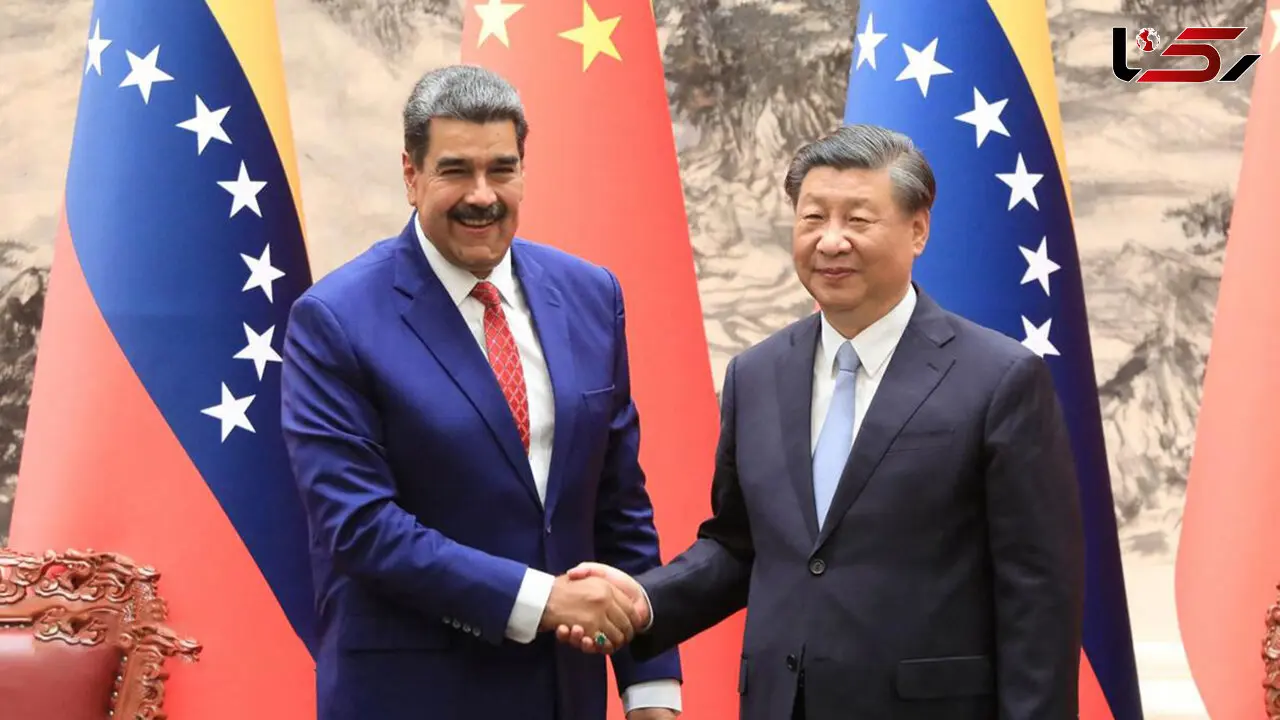
According to Rokna, citing BBC, China has made significant investments in Venezuela, one of its closest partners in South America. State media highlighted the meeting, showing smiling officials in suits reviewing some of the 600 active agreements between the two countries — yet the next image of Maduro showed him on a US warship, blindfolded and handcuffed, dressed in grey sweats.
China joined numerous countries worldwide in condemning Washington’s dramatic action against a sovereign nation, accusing the US of acting like a “global judge” and emphasizing that “the sovereignty and security of all nations must be fully protected under international law.”
Beyond these stern statements, Beijing is carefully weighing its next steps — not only to safeguard its position in South America but also to navigate an already delicate relationship with Trump, as the US-China great power rivalry takes an unexpected turn.
Some observers see opportunities for China’s authoritarian Communist Party leadership, yet significant risk, uncertainty, and frustration remain as Beijing determines how to respond after Trump effectively tore up the international rulebook that China had adhered to for decades.
China, which favors long-term strategies, is not a fan of disorder — yet chaos seems to be recurring in Trump’s second term. Beijing had planned ahead for the on-again, off-again trade war and weathered it successfully. Xi Jinping may feel he has demonstrated to the US and the world just how dependent they are on Chinese manufacturing and technology.
However, a new challenge now confronts Beijing. Trump’s push for Venezuelan oil likely intensifies China’s deepest suspicions regarding American intentions — specifically, how far the US is willing to go to curb Chinese influence.
Speaking to NBC on Sunday, US Secretary of State Marco Rubio stated: “This is the Western Hemisphere. This is where we live — and we will not allow it to be a base for adversaries, competitors, or rivals of the United States.” The implicit message to Beijing: stay out of our backyard.
China is unlikely to comply but will monitor developments closely. On Wednesday, Beijing strongly condemned a US report suggesting Washington might direct Venezuela’s acting president to cut economic ties with China and Russia.
Mao Ning, spokesperson for China’s Foreign Ministry, told reporters that such a move represents a “typical act of bullying, a serious violation of international law, a severe infringement on Venezuela’s sovereignty, and could significantly harm the rights of the Venezuelan people.”
Some analysts speculate whether China is observing to see if it could replicate similar tactics in Taiwan — the self-governing island it regards as a breakaway province. Xi has pledged that Taiwan will eventually be “reunified” with the mainland and has not ruled out the use of force. Chinese nationalists online have questioned: if the US can act unilaterally in Caracas, what would prevent Beijing from doing the same in Taiwan?
Beijing may not equate the situations, viewing Taiwan as an internal matter rather than an international issue. More importantly, David Sacks of the Council on Foreign Relations notes that even if Xi chooses military action, it would not be simply because of US precedent. China lacks “confidence that it can succeed at an acceptable cost.”
“Until that day comes, China will continue its strategy of applying pressure to wear down the people of Taiwan and bring them to the negotiating table. US actions in Venezuela do not alter this approach,” Sacks writes.
Instead, these developments present an unwanted challenge to China, threatening its long-term strategy to expand influence in the Global South.
The China-Caracas relationship had been straightforward: China needed oil, and Venezuela needed cash. Between 2000 and 2023, Beijing invested over $100 billion in Venezuela to finance railways, power plants, and other infrastructure projects. In return, Venezuela supplied the oil necessary to fuel China’s booming economy.
Last year, about 80% of Venezuelan oil exports went to China, though this accounted for only 4% of China’s oil imports. Eric Olander, editor-in-chief of The China-Global South Project, notes that “it’s important to maintain perspective regarding China’s financial exposure in Caracas.”
“Companies like CNPC and Sinopec are among the largest players there, and their assets could be nationalized by Venezuela, directed by the US, or sidelined amid the chaos,” Olander added.
Additionally, Venezuela owes around $10 billion to Chinese creditors, though it remains unclear whether current investments are at immediate risk. Nevertheless, this situation could discourage future investors. Cui Shoujun of Renmin University emphasized on Chinese state media that “Chinese enterprises must carefully assess the risks and potential US intervention before committing to related projects.”
China is determined not to jeopardize the fragile trade truce it recently signed with the US, yet it also seeks to maintain its foothold in Latin America — a balance that is particularly challenging with the unpredictability of Trump.
China’s concern extends to other South American nations, which may hesitate to welcome major Chinese investments out of fear of attracting unwanted US attention. Olander notes: “This region is a critical source of food, energy, and natural resources for China, with two-way trade now exceeding half a trillion dollars.”
The US has also made clear its expectation that Panama cancel all Chinese port holdings and investments related to the Panama Canal — a development Olander describes as “undeniably worrying for China.”
Consequently, Beijing may need to safeguard its interests in Washington’s backyard through alternative means. China has historically demonstrated patience and persistence in courting South America. The Global South is composed of nations advocating “a community with a shared future” and opposing “unilateral bullying.”
This message resonates with governments increasingly wary of the West, particularly Trump’s Washington. China has consistently been explicit with its partners about its demands — recognition of the “One China” principle and acknowledgment of Taiwan as part of China.
Over the past two decades, China has successfully persuaded several Latin American states — including Costa Rica, Panama, the Dominican Republic, El Salvador, Nicaragua, and Honduras — to switch diplomatic recognition from Taiwan to China, favoring strategic partnerships with Beijing’s $19 trillion economy.
In contrast, Trump has shown that relationships with Washington can be volatile, which may advantage China as it projects Xi Jinping as a stable leader more than ever.
Olander adds: “This situation is critical because Venezuela could quickly descend into chaos. Also, consider Iraq — the US claimed the country’s oil would fund reconstruction, but it did not. China is now the largest buyer of Iraqi crude. A similar scenario could unfold in Venezuela.”
For years, US lawmakers, particularly China hawks in Congress, pushed for measures to counter Beijing’s influence in South America. The US has acted, but uncertainty remains regarding its next steps.