

“US Submarines Pose Greater Threat Than Aircraft Carriers: Iran’s Anti-Submarine Strategy Examined”
Rokna Political Desk: Mohammad Moonsan writes in a commentary for Iranian Diplomacy: Let us assume that if an aircraft carrier positions itself at a distance of one thousand kilometers from an enemy’s coastline, its aircraft are forced to fly the outbound route…
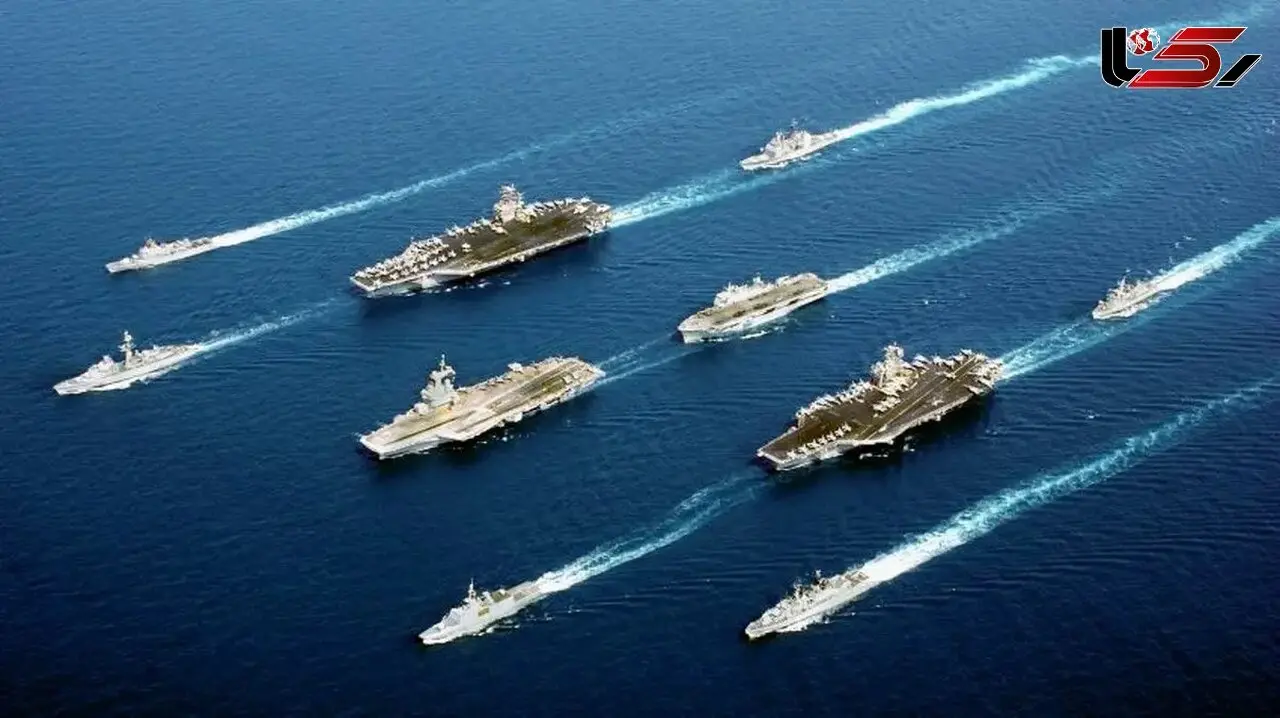
According to Rokna, citing Iranian Diplomacy, at a time when numerous reports have emerged regarding the concentration of the US naval fleet around southern waters and the possibility of an American attack on Iran, a common misconception has taken shape: that aircraft carriers, by approaching the coastline, would carry out the initial strikes. This article seeks to analyze this assumption.
Submarines on the Front Line
Numerous US Navy documents state that in a maritime assault on adversaries, the initial missile strikes aimed at suppressing the enemy’s air and naval defenses—from coastal areas deep into the mainland—are the responsibility of submarines, in order to pave the way for aircraft carriers to move closer and for fighter jet operations to begin.
Aircraft carriers are extremely large vessels that can be targeted by missile and drone attacks as well as unmanned surface and subsurface systems. For this reason, they operate with an escort fleet consisting of several destroyers and frigates and typically maintain a safe distance from enemy coastlines. Submarines, however, due to their stealth, face far fewer limitations. They can approach much closer to shore—at distances of approximately 300 to 500 kilometers—and carry out missile strikes. If they determine that the targeted country lacks effective anti-submarine warfare (ASW) capabilities, they may approach even closer.
Submarines attempt, through multiple waves of attacks, to destroy the most critical radar systems and air and naval defense assets of the enemy, thereby clearing the path for aircraft carriers to move forward. A nuclear-powered ballistic missile submarine (SSBN) carries approximately 350 tons of armaments, while an attack submarine (SSN) carries around 150 tons. Consequently, their offensive and destructive capabilities are extraordinarily high.
In the US strike on Iran’s nuclear sites on Tir 1 (June 21), thirty Tomahawk missiles with ranges of up to 2,500 kilometers were launched from northern parts of the Arabian Sea. These missiles are capable of reaching deep into Iranian territory.
Once air and naval defenses are suppressed, aircraft carriers can move closer. They are compelled to do so because fighter jets, unlike missiles, must return after completing their missions and therefore face range limitations. For example, the F‑35 fighter jet has a ferry range of 2,800 kilometers without weapons and a combat range of 1,200 kilometers with weapons (an operational radius of 600 kilometers). The F‑16 has a ferry range of 4,200 kilometers without weapons and a combat range of 700 kilometers with weapons (an operational radius of 350 kilometers).
If we assume an aircraft carrier stands 1,000 kilometers from an enemy’s coastline, its aircraft would be forced to fly a 2,000‑kilometer round trip merely to reach the coast, severely limiting their ability to penetrate inland. As a result, carriers are compelled to approach much closer to the enemy’s shores—between 200 and 300 kilometers—where they then face the enemy’s naval and air defenses. Therefore, fighter jet operations from aircraft carriers only begin once air and naval defenses have already been suppressed and the carriers can approach the coastline with greater confidence.
The Best Defensive Tool: Detecting and Repelling Submarines
Based on the above, the most effective way to counter enemy missile and air attacks is to keep submarines at a distance. The moment a submarine realizes it has been detected, it will withdraw from the area, as stealth is its most critical advantage. A detected submarine becomes a moving target; due to its lower speed compared to surface vessels, it can be destroyed through depth charges and torpedoes launched by ships, aircraft, or helicopters. Consequently, once detected, a submarine will immediately flee the area.
Iran’s Situation in Anti-Submarine Warfare
From a general perspective, it appears that Iran has unfortunately not focused sufficiently on anti-submarine warfare in open seas such as the northern Arabian Sea. This is why the US attack on Tir 1 was easily carried out by an Ohio-class submarine.
The most effective means of tracking a submarine is another submarine. Unfortunately, due to a traditional—and incorrect—approach in the past, the majority of Iran’s submarines are small Ghadir-class vessels that are incapable of operating in open oceans. Only one Fateh-class submarine has been built, and it too lacks the capacity for long-term deployment in open waters.
Today, one of the most affordable and reliable methods of submarine detection is the use of unmanned maritime systems, including surface unmanned vessels (ASVs) and underwater unmanned vehicles (AUVs). Because they are unmanned, these platforms do not face human limitations or risks during prolonged operations in rough oceanic conditions. They are small, inexpensive, and suitable for mass production. Equipped with underwater listening devices, if deployed in large numbers across the Sea of Oman and the northern Arabian Sea, they could effectively render the maritime environment unsafe—and effectively transparent—for submarines.
Iran possesses a limited number of large and expensive reconnaissance vessels, but these are not optimal options, as they could be easily destroyed in the initial hours of conflict. Large numbers of unmanned systems, however, present a different equation altogether.
Another suitable recommendation under current conditions is the installation of listening and tracking equipment on a large number of inexpensive but sizable dhows, fishing vessels, and service ships capable of long-term operation in rough open seas. Typically, hydrophones are lowered into the water via cables and ropes to depths that allow them to listen beneath surface noise. Once a submarine is detected and its position determined, harassment or destruction operations can commence.
Globally, anti-submarine drones equipped with lightweight torpedoes and naval mines now exist. Once a submarine’s location is identified, these drones rapidly reach the area and deploy their weapons. These are inexpensive, unmanned, and scalable systems designed for anti-submarine operations across vast oceanic spaces.
Despite Iran’s advanced drone technology, there has been no public indication of anti-submarine drones. Submarines must rise from great depths to around 30 to 50 meters below the surface to launch missiles, making them highly vulnerable and easier to target. Another method of submarine detection is satellite surveillance, an area in which Iran currently lacks achievements.
Iranian naval commanders must understand one critical point: “The center of gravity and backbone of the enemy’s surface fleet are its submarines. By pushing submarines away, surface fleets become far more vulnerable.” Undersea and anti-submarine warfare must receive far greater attention from Iran’s military leadership than in the past.
Another highly important factor in undersea warfare is its relative immunity to electronic warfare. In recent days, several US electronic warfare aircraft have entered the region, indicating the emphasis placed on such capabilities. Autonomous underwater vehicles can patrol intelligently, detect targets, and even conduct attacks without being affected by electronic warfare. These armed autonomous submarines are now referred to as XLUUVs. Greater focus on unmanned maritime systems—particularly underwater drones—would fundamentally transform the battlefield.
Why the United States Is Forced to Rely on Aircraft Carriers
Under current conditions, if the United States were to use air bases in neighboring countries, it would inevitably face Iranian attacks on those countries—many of which possess vast oil and gas reserves—thus triggering a widespread energy crisis. Moreover, it is unlikely that neighboring countries would accept such risks or willingly enter an unwanted war.
Attacks from Non-Neighboring Countries
There is a possibility of attacks launched from non-neighboring countries such as Jordan. However, due to aircraft range limitations, such operations would require aerial refueling tankers. These aircraft are large, slow, and operate at high altitudes. In reality, they represent the Achilles’ heel of long-range air attacks. If refueling aircraft are destroyed in the air or on the ground, aerial operations become impossible.
In recent weeks, multiple reports have emerged regarding Iran’s preparations to reliably target refueling aircraft, including the acquisition of long-range Chinese and Russian air defense systems and modern Chinese and Russian fighter jets capable of high-altitude air combat. During the 12-day war, Iran suffered severe weaknesses in this area, but over the past seven months these deficiencies have been significantly addressed. Consequently, long-range air attacks will no longer be as simple as they were during the 12-day war. Under these circumstances, aircraft carrier-based attacks once again appear to be the most viable option.
It Is Possible That Aircraft Carriers Will Not Be Used at All
One strong possibility behind the deployment of aircraft carriers is that their role is to divert Iran’s attention away from submarines. In such a scenario, the carriers themselves may never enter combat, as was the case in the Tir 1 attack on Iran’s Isfahan nuclear site, which was conducted solely by submarines.
Countering Attacks on Iran’s Air Defenses
Missiles launched from submarines typically strike fixed, pre-determined coordinates. Therefore, mobility effectively deprives the enemy of initiative. Mobile land- and sea-based systems are the best options, particularly offensive and defensive systems mounted on vessels capable of operating in open ocean environments. Naval assets stationed in the Persian Gulf are of little use against attacks originating from oceanic regions. In an actual conflict, enemy fleets would almost certainly be positioned several kilometers south of the Sea of Oman and the Arabian Sea. Preparedness for such environments is essential, especially vessels with strong seakeeping capabilities.
The time has come to move away from an excessive focus on speed and instead prioritize seakeeping capability and endurance in rough ocean conditions, along with the installation of advanced detection and missile systems. SWATH vessels represent an ideal option. When combined with unmanned systems, this missing link could secure oceanic areas for Iran across hundreds of miles.
How Can an Aircraft Carrier Be Sunk?
There is a common misconception that an aircraft carrier can be sunk with one or two missiles or drones, but this is not the case. These vessels are internally compartmentalized with numerous longitudinal and transverse bulkheads that prevent flooding from spreading if the hull is breached. They also possess a high level of buoyancy reserve, meaning they may remain afloat even after several compartments are flooded.
So how can an aircraft carrier be sunk? Naval and military engineers generally propose three main methods:
-
Destruction of the engine room at the stern, disabling propulsion;
-
Destruction of aircraft fuel storage areas, which are highly flammable and can cause massive explosions;
-
Detonation of weapons storage facilities, leading to catastrophic explosions.
The second and third targets are typically located in the lowest sections of the hull beneath the waterline, making them less vulnerable to missiles and drones. As a result, they must be targeted using underwater torpedoes.
Conclusion
Given Iran’s religious prohibition on nuclear weapons and the weakening of its deterrence—which has led to repeated threats and heavy attacks on Iranian territory—it is essential to maximize the use of existing defensive capabilities. In summary, the following measures are recommended:
Special focus on submarines and anti-submarine warfare as the Achilles’ heel of enemy naval forces; emphasis on sustained and long-term presence in rough, open ocean environments, particularly through small SWATH vessels; replacing excessive emphasis on speed with seakeeping capability to ensure stability for deploying long-range, high-speed missiles; greater focus on large numbers of unmanned maritime systems, especially underwater drones; a strategic shift toward XLUUVs; installation of offensive and defensive missile systems on most naval vessels to protect against initial enemy strikes; and the use of numerous dhows, fishing vessels, and service ships to install anti-submarine systems under current conditions.