

Foreign Ministry Spokesman:
The United States Is the Greatest Threat to International Peace and Security / Araghchi Met with “Esfandiari” in France + Video
Rokna Political Desk: The spokesperson of the Ministry of Foreign Affairs, referring to Australia’s action against the Islamic Revolutionary Guard Corps (IRGC), said: The recent move by the Australian government has no legal or factual basis and is merely a continuation of the same approach that was taken several months ago based on false pretexts and misinformation supplied by the intelligence services of the Zionist regime.
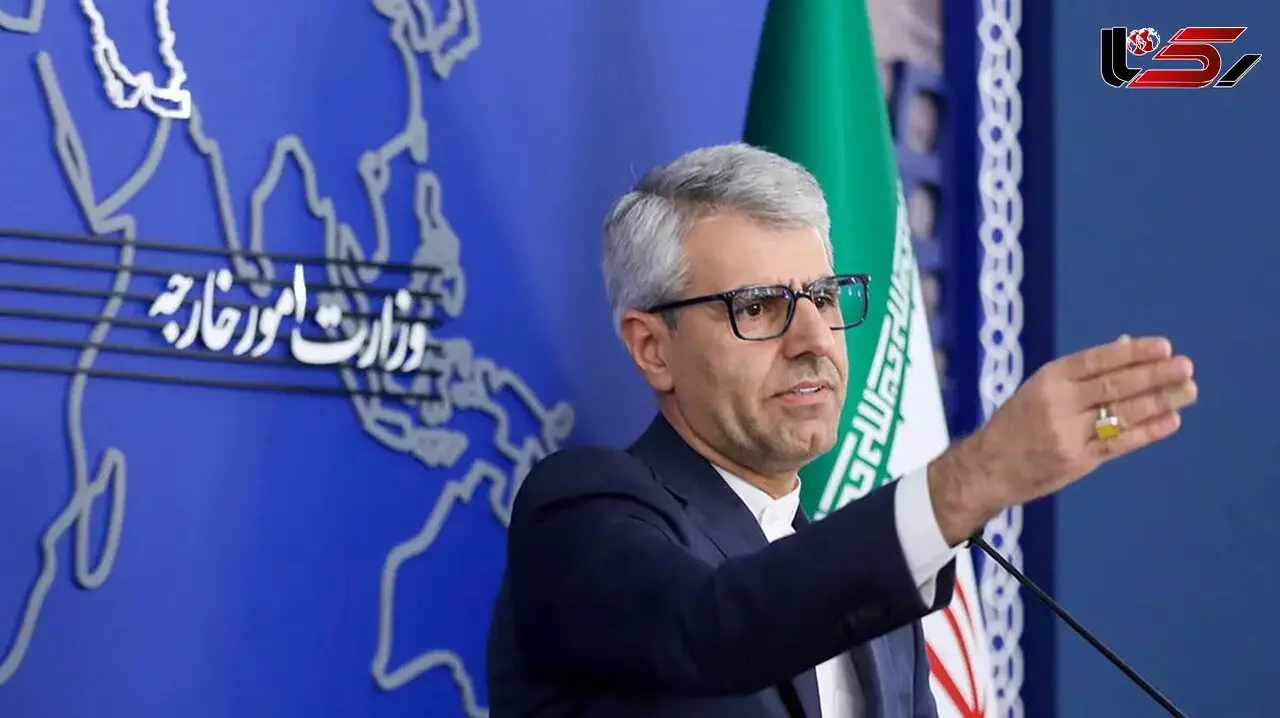
“Esmail Baghaei” on Monday, at the beginning of his press briefing, commemorated the occasion of Parliament Day.
Regarding diplomatic developments, the Foreign Ministry spokesman stated: The most important issue in the region remains the threat posed by the Zionist regime and its gross violations of international law against Lebanon and Syria. Despite the ceasefire in Lebanon and Gaza, the violations have sharply increased, with hundreds of ceasefire breaches recorded. In Gaza alone, the number of violations has reached nearly 600. Each violation is accompanied by the killing of innocent people. Unfortunately, international institutions have failed to take effective measures.
Declaring a Country’s Airspace Closed Is an Unprecedented Act
He added regarding U.S. actions against global peace: The reality is that the United States has become the greatest threat to international peace and security. We are witnessing the blatant use of force by the United States in Venezuela. Declaring the airspace of a country closed is an unprecedented act that violates international law.
U.S. threats against African countries, including statements that they are not permitted to participate in the G20, along with actions in our region and support for the crimes of the Zionist regime — all of these require the UN Security Council to determine that America’s actions are contrary to international peace and security. U.S. behavior is becoming a model for other actors, and the consequences of this situation will affect every government.
Iran and Saudi Arabia Are Determined to Strengthen Stability in West Asia
Regarding the visit of the Saudi deputy foreign minister to Tehran, the spokesman said: This visit was part of a process that began two years ago. Relations between Iran and Saudi Arabia have been on a positive trajectory. Discussions were held on bilateral issues and regional matters, including Palestine, Lebanon, and Syria. This process reflects the determination of both countries to continue working together to strengthen stability in West Asia.
Australia’s Action Against the IRGC
Responding to Australia’s move against the IRGC, he said: We have officially expressed our position. Australia’s action certainly has no legal or factual basis. Based on a pretext or false information likely provided by the Zionist regime, Australia has damaged long-standing diplomatic relations between Iran and Australia and downgraded bilateral ties. We stated at the time that this accusation was absurd and baseless. Even Australian officials and Sydney police explicitly acknowledged that Iran had no involvement. It is clear that this action is a form of paying tribute to the Zionist regime. Recently, other accusations in Africa have been published, similar to the baseless claim regarding Mexico.
Araghchi’s Consultations with the EU Foreign Policy Chief and Trip to France
Baghaei said regarding Araghchi’s consultations with Kaja Kallas, the EU High Representative for Foreign Affairs, and his trip to France: The foreign minister’s trip to France was at the invitation of his French counterpart to discuss bilateral matters and international developments. Naturally, the nuclear issue was also among the topics. This round of talks was exclusively with France. Our interactions with the EU foreign policy chief have continued and cannot be viewed as directly related. The call had been arranged previously. In the conversation with Ms. Kallas, discussions were also held on matters raised in France.
Repeated Ceasefire Violations in Lebanon by the Zionist Regime
Regarding the Lebanon ceasefire and its violation by the Zionist regime, the spokesman stated: It is well known that Israel enters a ceasefire only to violate it. The figure of 10,000 ceasefire violations has been reported by a UN rapporteur. Essentially, there is no ceasefire. The Israeli side is not committed to any pledge and uses the ceasefire merely as a pretext for further attacks in Lebanon and the killing of Lebanese civilians. The regime is targeting the development and welfare of Lebanese citizens. This situation increases the responsibilities of ceasefire guarantors, who have taken no meaningful action.
Araghchi’s Meeting with Mahdieh Esfandiari
Baghaei, discussing the situation of Mahdieh Esfandiari — detained in France — said: One aspect of Iran’s national interest is protecting its citizens. Therefore, supporting our nationals is part of our national interests. Mr. Araghchi met with Ms. Esfandiari, and fortunately, she is in good condition. We hope she returns to the country soon.
Australia’s Move Against the IRGC Has No Legal or Factual Basis
Responding again to a question on Australia’s decision, the Foreign Ministry spokesman said: Australia’s recent action has no legal or factual foundation and is a continuation of the same approach taken months ago, based on false information planted by the Zionist regime’s intelligence services. This action has damaged the long-standing diplomatic relationship between Iran and Australia.
He added: Iran has repeatedly stated that these allegations are entirely baseless and absurd. During this period, even Australian state officials, including police in Sydney, officially confirmed that Iran had no involvement in acts targeting Jewish entities. It is therefore clear that this action was taken merely to appease the Zionist regime.
He emphasized that Iran calls on all countries to be vigilant regarding the Zionist regime’s efforts to undermine Iran’s friendly relations with other nations. Similar unfounded accusations have recently emerged in Africa, like the baseless claim concerning Mexico, which was quickly denied by Mexican officials.
U.S. Action Against Iranian Nationals and 19 Other Countries
Regarding U.S. measures against nationals of Iran and 19 other countries, the spokesman stated: As far as we are concerned, our duty is to defend Iranian citizens. This is another example of the racist outlook dominating the American governing system and shows that nationals of 20 countries have become bargaining chips in domestic U.S. political disputes.
Erdogan’s Trip to Tehran and Talks on Disarming PJAK
Regarding President Erdogan’s planned trip to Tehran and discussions on disarming PJAK, he said: Coordination for the Turkish president’s visit is ongoing, and discussions are being held regarding the exact date.
On counter-terrorism, he noted: Our principled stance is that terrorism, anywhere, is condemned. Terrorism creates insecurity in every region, and the foreign minister emphasized the need for a terrorism-free region. Regional cooperation must therefore continue. Both ministers agree that cooperation among regional countries must be enhanced.
Iran’s Right to Peaceful Nuclear Energy
Regarding Iran’s right to peaceful nuclear energy, Baghaei stated: Iran’s actions focus on exercising the rights granted to it under the Non-Proliferation Treaty. This issue was imposed upon us, and naturally, discussions of “deadlock” lack validity. The opposing parties must refrain from using coercion. The solution to removing the nuclear issue from the agenda is acknowledgment of Iran’s rights under the NPT. Iran, having accepted its obligations, remains determined to utilize its rights, as emphasized in every negotiation.
Saudi Deputy FM’s Visit Focused on Syria
Speaking about the Saudi foreign ministry official’s visit, the spokesman said: This trip was in response to Mr. Sheibani’s visit months earlier. Issues concerning Syria and the region are important to us, and this visit focused mainly on Syria. Meetings with the Iranian special envoy on Syria were also held. We engage not only with Saudi Arabia but with other parties regarding Syria, aiming to improve regional security and enhance mutual understanding.
Claims About Iranian Interference in Lebanon Are Meaningless
Responding to protests in Lebanon regarding Iran, he said: Claims of Iranian interference in Lebanon’s affairs are baseless. We do not intervene in Lebanon. Lebanon is continuously facing attacks by the Zionist regime, and we support Lebanon’s inherent right to self-defense — a principle any country may adopt. Those interfering in Lebanon are parties that impose deadlines on its people.
Iran has always shown that it remains on the path of friendship and support for the Lebanese people.
Iran’s Approach to Negotiations
Regarding Iran’s approach to negotiations, Baghaei said: Our stance has always been consistent. We have stated that negotiations are meaningful only when both sides recognize each other’s legitimate rights. We have not taken retaliatory actions; rather, European countries, by proposing resolutions, created an impasse. There are numerous examples of the three European states abandoning their commitments under U.S. pressure.
Dialogue is an essential part of diplomacy, and new pathways may open in such exchanges. Araghchi’s visit to France and his talks with Ms. Kallas followed ongoing consultations with European states, and we will continue this process.
Iran Conducts Counter-Terrorism Exercises
The Foreign Ministry spokesman said: A counter-terrorism exercise is currently underway in northwestern Iran, with the field participation of five countries and the involvement of 13 to 14 additional countries.
This exercise demonstrates Iran’s commitment to coordinated, multilateral efforts against terrorism — a transnational challenge that no single country can address alone.
Such multilateral cooperation can serve as a starting point for expanding collaboration in various areas of international security.
Iran hopes that this cooperation will expand beyond counter-terrorism to include combating transnational organized crime.
We Will Not Allow the Zionist Regime’s Fantasies to Materialize
Regarding the presence of U.S. fighter jets in Iraq, regional developments, and Netanyahu’s remarks suggesting a new crisis, the spokesman said: We have not received any warning. Discussions with Turkey and Saudi Arabia concerned international developments. In every dialogue, the crimes and warmongering of the Zionist regime are addressed.
Regarding threats and crisis rhetoric, he said: The Zionist regime is inherently crisis-making. For eight decades, it has continuously spread instability around it. The entire region agrees on the threat posed by the regime. Iran is fully prepared under all circumstances — with the spirit of the Iranian nation’s heroic defense — and will not allow the Zionist regime’s fantasies to be realized.
Response to Europeans’ Statements on Negotiating with the U.S.
Responding to European statements about starting negotiations with the U.S., he said: Repeating claims of readiness for negotiations does not change the fact that the other side is not prepared. Europeans do not believe they can play an independent role and lack such capability. Their statements are largely rhetorical rather than tangible, goodwill-based positions.
U.S. Actions Are Destabilizing the World
Regarding a published article about the collapse of the non-proliferation regime, Baghaei said: This reflects reality — the United States is the biggest challenge to maintaining the non-proliferation system. Closing one's eyes to the massive WMD arsenal of a state engaged in continuous crimes, while the U.S. announces it will resume nuclear testing — this, along with its attacks on Iran’s peaceful nuclear facilities, proves the U.S. is the greatest threat to international peace and security.
Governor of the Central Bank’s Trip to Afghanistan
Baghaei stated regarding the visit of the Central Bank governor to Afghanistan: This trip was conducted and was important. Prior to that, positive discussions had been held between the Foreign Ministry’s economic diplomacy sector and Afghan officials. Our relationship with Afghanistan is significant in various dimensions, including trade. Proposals such as establishing border markets and facilitating customs procedures have been raised to strengthen cooperation. The central bank governor’s visit was within this framework.
Inspections and Interaction with the IAEA
Regarding inspections and interaction with the IAEA, he said: Our obligations are clear. All our nuclear activities under IAEA oversight remain under inspection. The IAEA must hold accountable those responsible for the current situation. All Iranian sites were under IAEA monitoring, and the military aggression and criminal acts by the U.S. and the Zionist regime created this situation. The agency must question them. The IAEA and the Security Council did not even issue a simple statement condemning the attacks by the U.S. and the Zionist regime. In such conditions, the IAEA cannot make claims. Leakage of radioactive materials is dangerous, preventing inspections. There is also no established protocol for such scenarios, and there is no precedent of an IAEA member’s nuclear facilities being attacked.
Iran’s Embassy in Venezuela Remains Fully Active
Regarding U.S. threats against Venezuela, Iran–Venezuela ties, and potential evacuation of Iranian nationals, the spokesman said: The very posing of this question is in a sense an insult to the Venezuelan people. There is no justification for any state to undermine another nation’s right to self-determination based solely on bullying. Our relations with Venezuela are based on mutual respect, and we have always expressed solidarity with the Venezuelan people.
America’s accusations are merely pretexts. International bodies have confirmed that Venezuela plays no role in drug trafficking. Our embassy in Venezuela remains fully active. What requires attention is that serious action must be taken against America’s aggressive unilateralism, preventing it from becoming a broad threat to order in the Western Hemisphere.
Attacks on Gas Fields in the Kurdistan Region of Iraq
Regarding the attacks on gas fields in the Kurdistan Region of Iraq, Baghaei said: We have expressed our concern about anti-security actions in Iraq. Attacks on gas fields in the region are absolutely condemned from our perspective, and we support any effort to cooperate with Iraqi authorities to ensure security. There are regional actors that contribute to instability. The Zionist regime uses every means to fuel insecurity.
Iran–China Cooperation Process
Regarding the progress of Iran–China cooperation, the spokesman said: Our assessment is positive. The Iran–China cooperation agreement includes multiple components, and the implementation process has so far been positive. Both sides remain committed. In long-term cooperation frameworks, removing obstacles during implementation is natural and is one of the strengths of Iran–China joint efforts.
Iran–China Railway Corridor
Regarding the Iran–China railway corridor, Baghaei said: This route is very important to us. Our colleagues at the foreign ministry and the ministry of roads are in talks with the Chinese side. We hope the process is finalized in the shortest possible time.
Send Comments