

IRGC’s Invisible Missile Cities: Enemy Bunker-Busters Cannot Penetrate + Video
Rokna Political Desk: The IRGC’s missile cities, as one of the main pillars of the country’s defensive strategy, have played a decisive role in enhancing deterrence power and changing regional security equations.
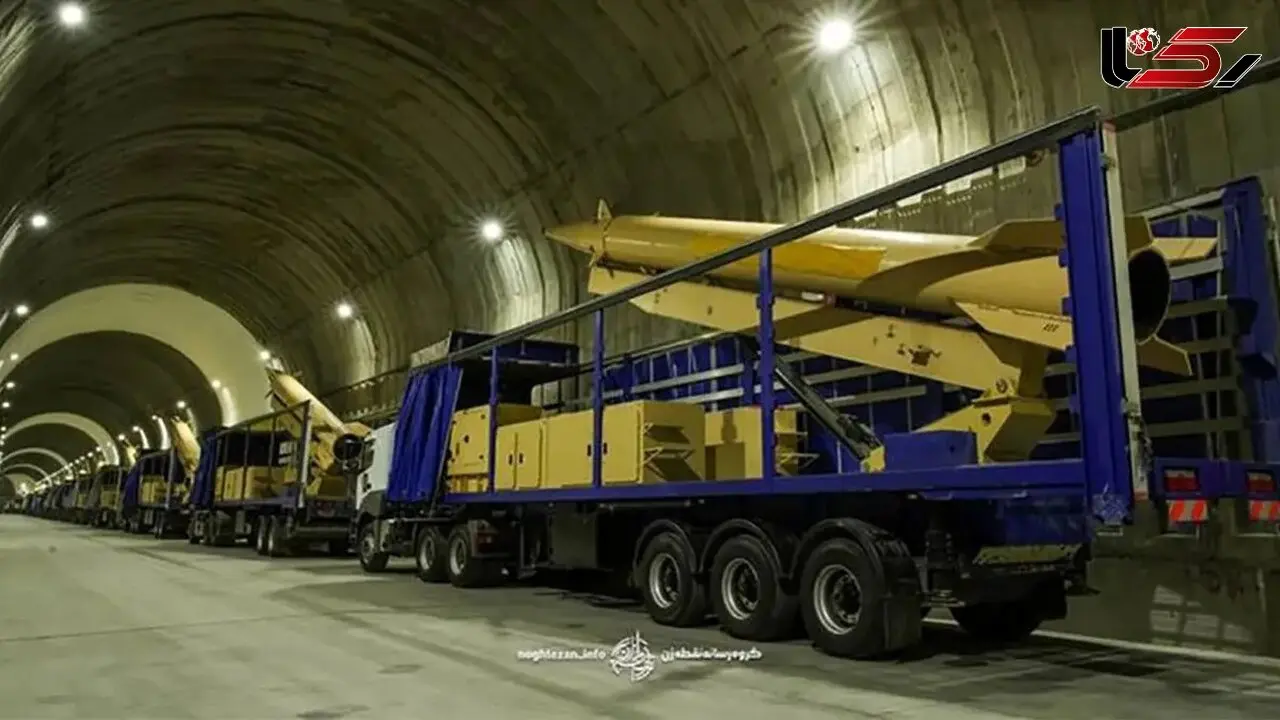
“We have no limitations on the number of missiles, and based on our current inventory, if we wish, we could inaugurate a missile city every week, and this process could continue for up to two years. This capacity includes various types of missiles with different ranges, and so far, none of these cities have been damaged,” said former IRGC Commander-in-Chief Major General Aziz Jafari.
These remarks come while the enemy and its affiliated media have repeatedly claimed that during the 12-day imposed war, Iran’s missile cities were targeted.
However, the Iranian Armed Forces, during Operation “Va‘de Sadeq 3,” struck more than 26 strategic targets of the Israeli army over 22 waves of attacks. The Islamic Republic’s most significant capability in responding to the enemy was the use of long-range and precision ballistic missiles, which successfully destroyed a wide range of military targets in the occupied territories.
The Concept of Iran’s Missile Cities
The IRGC Aerospace Force, which plays a central role in Iran’s missile strikes against the occupied territories, pursues multiple missile-related projects, one of which is the “missile cities,” the first of which was unveiled in October 2015 at a depth of 500 meters underground.
Nasser Kaveh, a comrade of the late Hajizadeh, stated: “Commander Hajizadeh was the first in the Islamic Republic to launch the missile cities initiative and was its founder. He started the project with a few young men, initially building tunnels and depots, and gradually the cities took shape, all with basic equipment and a very limited budget.”
Following the implementation of Operations Va‘de Sadeq 1 and 2, the IRGC continued its determination to strengthen the country’s defensive capabilities and carried out effective measures along this path.
Two New Iranian Missile Cities After Va‘de Sadeq 1 and 2
On January 10, 2025, one of the new IRGC missile cities was unveiled, housing four types of missiles: the “Emad” with a range of 1,700 km, “Qadr H” with a range of 1,650 km, “Qadr F” with a range of 1,950 km, and “Ghiam” with a range of approximately 800 km, ready for use in response to enemy aggression.
According to the late IRGC Commander-in-Chief Major General Salami, “The enemy believed our production capability had stopped, but our missile power growth rate is up to date.”
On March 25, 2025, the IRGC unveiled its latest missile city, which houses missiles including “Kheibarshkan” with a 1,450 km range, “Haj Qasem” with 1,400 km, “Qadr H” with 1,650 km, “Sejil” with 2,000 km, “Emad” with 1,700 km, and the cruise missile “Paveh” with 1,650 km. Each of these missiles is capable of destroying critical areas in the occupied territories, a capability fully demonstrated during Operation Va‘de Sadeq 3.
Unveiling Two Upgraded Missiles in a Missile City After Va‘de Sadeq 3
Recently, two upgraded Emad and Qadr missiles of the IRGC Aerospace Force were unveiled in one of the underground missile cities. The precision ballistic Qadr missile is equipped with electronic warfare countermeasures, while the Emad missile is upgraded and fully operational.
Enhancing Survivability and Arms Security: Underground missile bases protect missiles and military equipment against airstrikes and enemy reconnaissance, enabling launches from unexpected locations.
Strengthening Deterrence and Rapid Response: Deploying missiles in these cities increases Iran’s rapid response capability and counterattack potential, serving a deterrent role.
Increasing Defensive Flexibility: Safe mobility of missiles, implementation of deception tactics, and launches from multiple angles create diverse defensive and offensive scenarios.
Long-Term Storage and Maintenance: Underground temperature and humidity control ensures missile protection from environmental damage and enemy attacks, increasing their lifespan and operational readiness.
Enemy Bunker-Busting Bombs Cannot Penetrate
One of the threats posed by the enemy regarding Iran’s underground military cities is that bunker-busting bombs or missiles could destroy them. However, military engineering experts state that these cities are designed so that enemy bunker-busting bombs cannot penetrate. The head of Iran’s Passive Defense Organization, Major General Gholamreza Jalali, also stated, “Missile cities are a symbol of successful passive defense.”
Underground Bases Not Limited to Military Use
Construction of underground bases is not limited to the military sector but also extends to strategic sites such as nuclear enrichment facilities. Experts believe that building underground bases in Iran’s Armed Forces is a key and fundamental strategy intended for expansion across all sectors.
The IRGC’s missile cities play a vital role in enhancing the country’s deterrent and defensive capabilities. These underground bases, located across the country, enable rapid deployment, preparation, and launch of various precision and long-range missiles, significantly boosting Iran’s defensive power.
Send Comments